
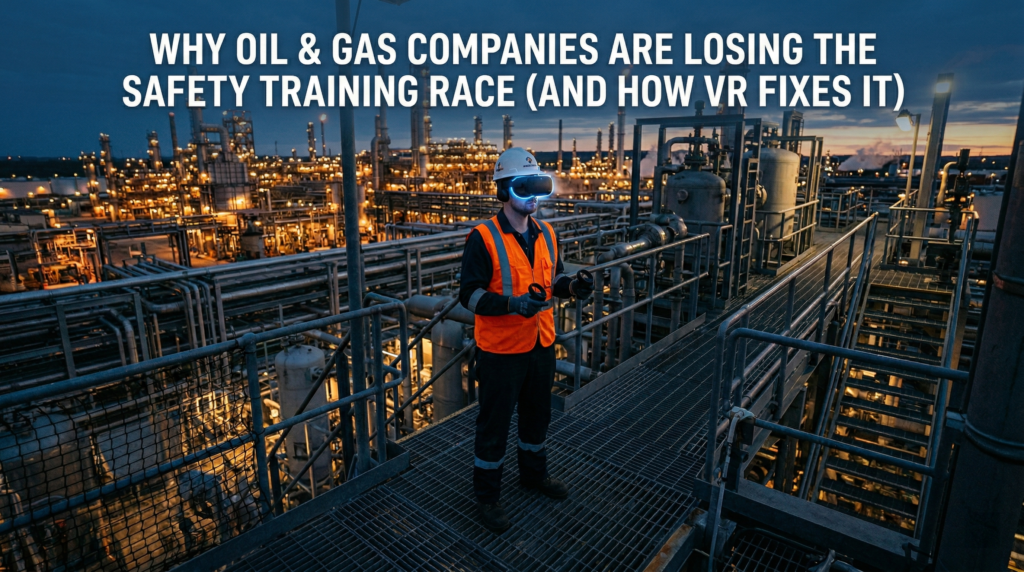
Upstream oil and gas operations have never moved faster. Automated rigs, digital twins, AI-driven predictive maintenance, IoT-connected equipment — the pace of technology adoption across the sector has compressed what used to take a decade into a few years. That's mostly good news. But there's a problem nobody talks about at the leadership level: the workforce has no way to keep up.
Traditional safety training — classroom sessions, printed SOPs, eLearning modules built five years ago — was designed for a different era. It assumed a relatively stable set of equipment, procedures, and risk profiles. That assumption no longer holds. When the technology changes faster than the training, the gap between what workers know and what they need to know quietly widens. Incidents follow.
"The technology's outpacing the training. Workers are being put in front of equipment they've never seen in a classroom, let alone practiced on."
This is the safety training race. And right now, most oil and gas companies are losing it.
The problem with classroom training in a digital oilfield
Classroom-based safety training has real strengths. It builds relationships, enables discussion, and works reasonably well for foundational knowledge. But it has three structural problems that become critical as operations get more complex.
First, it doesn't transfer. Workers can sit through a four-hour module on H2S exposure, pass the test, and still freeze when a real alarm sounds. Knowledge retention from traditional instruction drops sharply within 72 hours. Without repeated exposure to realistic scenarios, procedural memory doesn't form.
Second, it can't keep pace. When a facility installs new automated control systems, upgrades valve configurations, or changes emergency protocols, updating classroom content takes weeks. VR simulation environments can be updated in days, with all workers across all sites trained on the new procedure before the change goes live.
Third, it doesn't produce usable data. A completion certificate tells you a worker sat through a training session. It tells you nothing about whether they can perform under pressure. Enterprise VR training captures reaction times, decision points, errors made, scenarios failed — performance data you can act on.
Knowledge retention after 1 week — training method comparison
% of training content retained by participants
Sources: Finance Online; PwC VR Workforce Study; National Training Laboratories
The ESG pressure that's changed the conversation
For years, safety training investment was driven by regulatory compliance. Meet the minimum standard, keep the certificates current, avoid fines. That calculation has shifted.
In 2026, ESG scores directly affect access to capital. Investors and major institutional lenders screen on safety records, incident rates, and training maturity as part of their social responsibility criteria. A poor safety record doesn't just mean regulatory exposure — it affects bond ratings, insurance premiums, and the cost of the next capital raise.
The companies winning on ESG aren't treating safety training as a compliance checkbox. They're treating it as an operational capability. There's a difference. Compliance training asks: "Can we prove our workers completed the module?" Operational capability training asks: "Can our workers actually perform the procedure under pressure?"
VR simulation is what makes that second question answerable at scale.
Business areas affected by poor safety training performance
% of oil & gas executives citing this as a material risk (2025–2026)
Source: IHS Markit Energy Workforce Report 2025; ESG capital allocation research composite
What traditional training gets wrong about high-hazard environments
Oil and gas sites share a specific training challenge that most L&D frameworks weren't built for: the most important scenarios to train on are also the most dangerous and expensive to simulate in real life.
You can't practice a wellhead pressure event in a classroom. You can't run through an H2S emergency response drill with the real equipment without shutting down production. You can't let a new hire make mistakes on a pressure control system during commissioning. In traditional training, workers often encounter the actual hazard before they've had real practice responding to it.
VR removes that constraint. Workers can experience a simulated blowout, practice the correct shutdown sequence, fail, reset, and repeat — without any operational risk. The scenario is realistic enough to engage muscle memory and build procedural confidence. The data from each run tells supervisors exactly where the gaps are.
Traditional training vs. enterprise VR training: side-by-side
| Capability | Classroom / LMS | Enterprise VR (Vision Portal) |
|---|---|---|
| Simulate live hazard scenarios | ✗ Not possible without operational risk | ✓ Full scenario library, repeatable on demand |
| Performance data capture | ✗ Completion records only | ✓ Decision timing, error type, competency score |
| Multi-site deployment | ✗ Requires local instructors at each site | ✓ Deploy to all sites from a single platform |
| Update speed when procedures change | ✗ Weeks to update and redistribute | ✓ Push updates centrally within days |
| Regulatory compliance reporting | ✗ Manual record-keeping | ✓ Automated reporting dashboard |
| Knowledge retention after 1 week | ✗ ~20–30% | ✓ ~75% (Finance Online / PwC research) |
| Onboarding speed | ✗ Weeks for full certification | ✓ Up to 4× faster across enterprise deployments |
What closing the gap actually looks like
Toronto Hydro — one of Canada's largest urban electric utilities — faced a familiar problem. Training was mostly classroom-based. Procedural errors were tracked but hard to prevent. The gap between what workers learned and what they could reliably execute under field conditions was visible in the incident data.
After deploying VR Vision's enterprise platform, Toronto Hydro measured a 30% reduction in procedural errors across trained worker cohorts. Supervisors reported higher worker confidence going into high-risk tasks, and compliance tracking became significantly less manual.
That's one energy utility. The same mechanics apply across upstream oil and gas, where procedures are more complex, hazards are higher, and the cost of an error is orders of magnitude larger.
Procedural error rate: before vs. after VR training deployment
Indexed to baseline (100 = pre-VR error rate). Toronto Hydro deployment data.
Source: Toronto Hydro deployment via VR Vision Group. Error rate indexed to pre-deployment baseline = 100.
How enterprise VR training works in an oil and gas context
The Vision Portal platform handles the full training lifecycle for enterprise oil and gas operators — from initial deployment through ongoing compliance reporting. Here's how it fits into an existing operation:
-
1
Scenario design and site customization VR Vision builds scenarios specific to your equipment, site layout, and procedures — not generic simulations. Workers train on virtual representations of their actual environment.
-
2
Multi-site deployment via Vision Portal The platform manages hardware allocation, user assignment, and training schedules across all facilities from a central dashboard. No local IT infrastructure required at each site.
-
3
Performance data capture in real time Every session generates granular data — time to respond, errors made, procedures skipped, scenarios retried. Supervisors see competency scores at the individual and cohort level.
-
4
Compliance reporting and audit trail Vision Portal automatically generates the documentation regulators require — completion records, competency evidence, and training history — reducing the administrative burden on HSE teams.
Who this is built for
Vision Portal is an enterprise platform designed for organizations running complex, multi-site operations in high-hazard industries. It's not a standalone VR app — it's a managed training infrastructure that integrates with existing LMS and HRIS systems.
Current deployments span upstream oil and gas, utilities, manufacturing, and rail. Common entry points include new equipment commissioning, compliance refresh cycles, and high-turnover workforce onboarding programs.
The cost of waiting
The conversation around VR training has been happening in oil and gas L&D circles for several years. The barrier has usually been one of three things: perceived complexity, unclear ROI, or lack of internal champion.
Those barriers are shrinking. The technology has matured. The ROI is measurable. And as ESG pressure tightens, the organizations that get serious about training data — not just completion rates — will have a structural advantage in workforce performance, regulatory standing, and capital access.
The gap between technology adoption and workforce readiness doesn't close on its own. It widens, quietly, until something goes wrong.
Cost comparison: VR training investment vs. single lost-time incident
Illustrative cost ranges for a 500-person upstream operations workforce
Sources: NSC Injury Facts; IOGP Safety Performance Indicators; upstream O&G incident cost averages
Frequently asked questions
How is VR training used in oil and gas?
VR training in oil and gas simulates high-hazard scenarios — equipment failures, H2S exposure, pressure events, and emergency response — in a safe, repeatable environment. Workers practice correct procedures without operational disruption or physical risk, with all performance data captured for compliance tracking.
What is the ROI of VR safety training in the energy sector?
Organizations using enterprise VR training have reported up to 30% reductions in procedural errors, significant decreases in incident-related costs, and faster onboarding for new hires. Toronto Hydro achieved a 30% reduction in errors after deploying VR Vision's platform. Given that a single lost-time incident in upstream oil and gas can exceed $1.5M in direct and indirect costs, the payback period on VR training investment is typically measured in months.
Can VR training meet regulatory compliance requirements in oil and gas?
Yes. Enterprise platforms like Vision Portal capture granular performance data, completion records, and competency assessments that satisfy regulatory reporting requirements under OSHA, CSA, and ISO frameworks. Automated reporting dashboards reduce the manual burden on HSE teams significantly.
How long does it take to deploy enterprise VR training across multiple sites?
Deployment timelines depend on the number of custom scenarios required and site count. Typical enterprise deployments run 8–14 weeks from kick-off to go-live, including scenario development, platform configuration, and user onboarding. Vision Portal's centralized architecture means subsequent sites are significantly faster to bring online.
See what VR training looks like for your operation
VR Vision works with upstream oil and gas operators to build custom simulation environments, deploy across multi-site workforces, and produce the compliance data your HSE team needs. Book a 30-minute demo to see Vision Portal in action.
Book a Demo