
VR Employee Onboarding That Gets New Hires Job-Ready Faster
VR employee onboarding lets new frontline hires walk your site, learn your equipment and practice their first real tasks before day one on the job. Instead of weeks of shadowing, they arrive knowing the layout, the hazards and the procedures, and supervisors can see exactly who is ready.
Why does frontline onboarding take so long?
Because most frontline onboarding still depends on classroom sessions followed by weeks of shadowing an experienced worker. It is slow, it pulls your best people off the job, and every new hire learns a slightly different version of the work.
- Time to productivity. New technicians and operators can take months before they work independently.
- Shadowing costs your experts. Senior staff spend hours repeating the same explanations instead of working.
- Early-tenure risk. New hires are most likely to make mistakes, and to get hurt, in their first weeks.
- Inconsistent starts. Onboarding quality depends on which site, shift and mentor someone lands with.
New to the technology? Start with VR Vision's guide to virtual reality training: what it is, what it costs and how to measure results.
How does VR onboarding work?
VR Vision turns your site, equipment and first-90-day tasks into a structured VR onboarding path. New hires complete it on a standalone headset, and each module has a guided mode to learn and an evaluation mode to prove competency before they move to supervised work.
Virtual site orientation
Walk a digital twin of the plant, substation or yard: layout, muster points, hazards and where everything is.
First tasks, hands-on
Practice the procedures a new hire will do in the first weeks, step by step, as many times as needed.
Safety before exposure
PPE, lockout/tagout and hazard recognition before anyone steps onto the floor. See industrial VR safety training.
Culture and context
Interactive 360 video that shows real teams, real sites and the customer impact of the work.
Same start at every site
Every new hire gets the same content and standard, whether they join at head office or a remote depot.
Readiness data
Supervisors see completion, scores and weak spots per new hire in Vision Portal before signing off.
Crews train on Meta Quest 3S or PICO 4 Enterprise headsets, with hand tracking supported. VR Vision is an authorized Meta and PICO partner, so hardware, device management and support come from one team. Sessions are tracked in Vision Portal, which supports SSO, MFA, role-based permissions and an on-prem or air-gapped option, with LMS integration (SCORM 1.2/2004, xAPI) available on request.
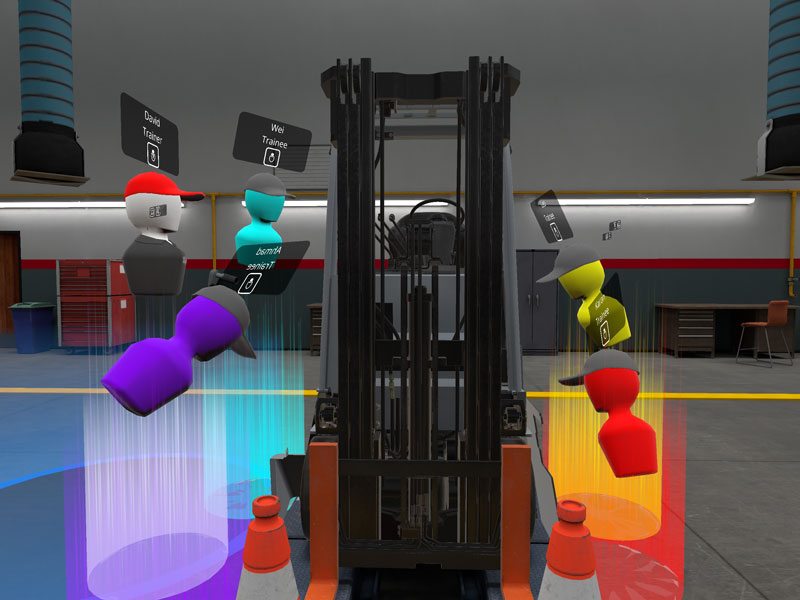
Want to see what day one looks like in VR?
Book a DemoWhat results have companies seen from VR onboarding?
These figures come from published VR Vision case studies.
Maintenance crews onboard faster and make fewer mistakes in the field, with one standardized VR training world across every site.
Read the Avangrid case studyHands-on training delivered at 200+ dealerships instead of at headquarters, saving $1.5M a year.
Read the Toyota Material Handling case studyHow is a VR onboarding program delivered?
Licensed modules reach a field pilot in 1 to 2 months. Custom builds reach a pilot in 3 to 4 months. VR Vision handles content, headsets, deployment and support, so your team is not running a software project on the side.
Discovery
Pick the tasks that carry the most risk, cost or training time, and agree how success will be measured.
Build or configure
License existing modules or build custom simulations from your drawings, photos, video and work methods.
Pilot
Run the training with a real group of learners, collect Vision Portal data and refine the content with your SMEs.
Roll out and measure
Scale across sites, with completion, scores and error data tracked per learner.
Budgeting? A custom VR project typically runs $60K to $120K, and interactive 360 video runs $30K to $60K per module. Model your own payback with the VR training ROI calculator, or compare vendors with the Industrial VR Training Buyer's Guide.
VR employee onboarding: frequently asked questions
What is VR employee onboarding?
VR employee onboarding uses virtual reality to orient new hires to their workplace and train their first tasks hands-on in a simulation of the real site and equipment, before they start supervised work.
Does VR onboarding shorten time to productivity?
Yes. Avangrid's maintenance technicians reached competency 65% faster than with traditional training, and Toyota Material Handling brought hands-on training to 10,000+ dealer technicians without travel to headquarters.
Which roles is VR onboarding best for?
It works best for frontline and technical roles where people must learn a physical site, equipment or safety-critical procedures, such as utility crews, plant operators, maintenance technicians and field service teams.
How much does VR onboarding cost?
A custom VR project from VR Vision typically costs $60K to $120K. Interactive 360 video costs $30K to $60K per module. Licensing existing modules, where they fit, is the fastest and lowest-cost way to start.
How long does it take to launch a VR onboarding program?
Licensed modules reach a field pilot in 1 to 2 months. Custom builds reach a pilot in 3 to 4 months, depending on the number of tasks and how quickly subject matter experts can review content.
Will it work with our IT, security and LMS requirements?
Vision Portal supports SSO, MFA, role-based permissions and an on-prem or air-gapped deployment option. VR Vision follows ISO 27001 practices and hosts on AWS, which holds the relevant certifications. LMS integration through SCORM 1.2, SCORM 2004 or xAPI is available on request.
Give every new hire a better first day
Book a 30-minute demo to see VR onboarding built on real sites and what a pilot for your next hiring wave would look like.