VR Safety Training That Prepares Industrial Workers for Hazards Before They Face Them
Industrial VR safety training uses virtual reality simulations of real facilities and equipment to train workers on hazard recognition, safety procedures and emergency response, without exposing anyone to live risk. VR Vision has spent 10+ years building engineering-grade, digital-twin safety simulations for companies like Toyota, Siemens Gamesa, Enel and Hydro One, training more than 100,000 workers across energy, utilities, manufacturing and other high-consequence industries.
Last updated September 2026 · 10+ years building enterprise VR safety training
What Is Industrial VR Safety Training?
Industrial VR safety training is the use of immersive virtual reality simulations to teach industrial workers how to recognize hazards, follow safety procedures and respond to emergencies in a realistic replica of their actual work environment. Instead of reading a manual or watching a video, workers practice high-risk tasks such as electrical switching, confined space entry and lockout/tagout hands-on, with zero physical risk.
The most effective programs are built on digital twins: engineering-accurate 3D replicas of a company's real substations, production lines, turbines or vehicles. A worker training on a digital twin of their own facility learns the exact equipment, layout and procedures they will encounter on shift one, not a generic scene.
VR safety training complements, rather than replaces, hands-on field training. It gives workers unlimited safe repetitions of dangerous scenarios before they ever face the real thing, and gives safety leaders documented, measurable proof that every worker completed the training and demonstrated competency. For a full grounding in the technology, see VR Vision's guide to virtual reality training.
Why Do Industrial Companies Invest in VR Safety Training?
Because traditional safety training has a gap: workers can pass a classroom test and still freeze, improvise or skip steps the first time they face a live hazard. The consequences of that gap are measured in lives and citations.
U.S. workers died from workplace injuries in 2024, one every 104 minutes. (BLS CFOI)
Nonfatal workplace injury and illness cases reported by U.S. private industry in 2024. (BLS)
Fall protection has topped OSHA's most-cited violations list for 15 consecutive years; lockout/tagout and machine guarding also rank in the top 10. (OSHA)
Look at what OSHA keeps citing: fall protection, hazard communication, lockout/tagout, powered industrial trucks, machine guarding. These are not exotic failures. They are training failures on well-understood hazards, the exact scenarios VR simulates best.
The economics compound the safety case. Live training on energized equipment, at heights or in confined spaces requires downtime, travel, standby crews and equipment that can't be in production. VR removes those constraints: the hazard is always available, the equipment never leaves service, and a mistake costs a reset instead of an incident. Estimate the savings for your own program with the VR training ROI calculator. Comparing vendors? Read the Industrial VR Training Buyer's Guide.
What Industrial Safety Topics Can Be Trained in VR?
Any high-risk, procedural or hazard-recognition scenario can be simulated. These are the eight use cases enterprise safety teams deploy most. For emergency drills and high-risk scenarios as a program, see VR safety and emergency response training.
Hazard Recognition & Assessment
Workers step into a simulated jobsite seeded with realistic hazards (exposed conductors, missing guards, unstable footing) and are scored on identifying, assessing and reporting each one before work begins. It builds the scanning habit that classroom slides cannot.
Electrical Safety & Arc Flash
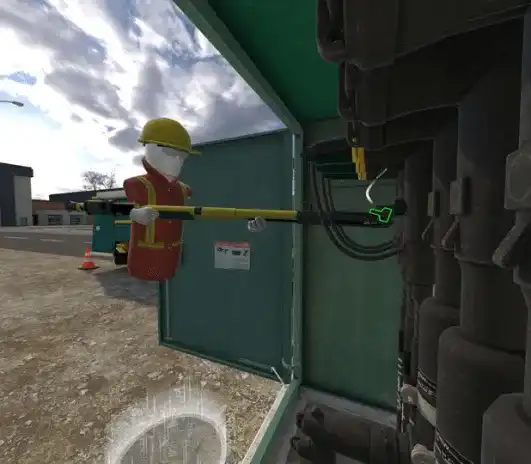
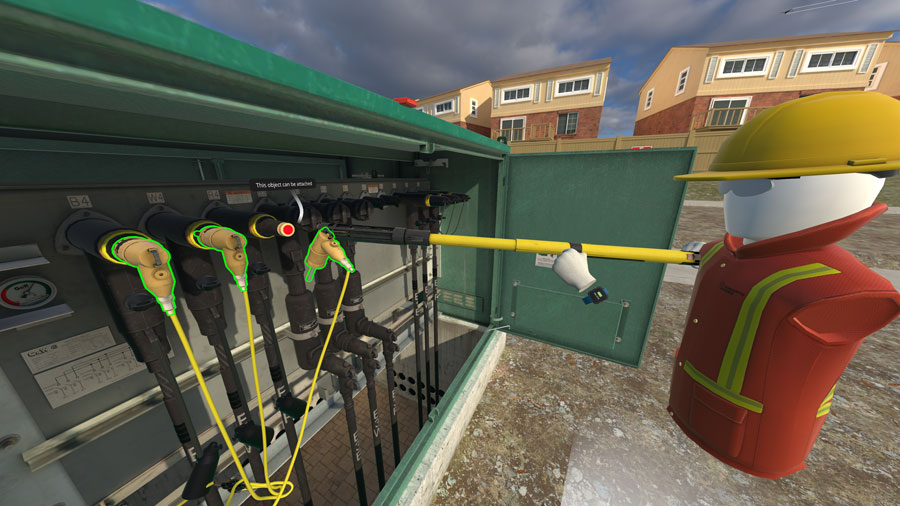
Electrical workers practice approach boundaries, PPE selection and switching procedures around energized equipment, and experience the consequences of an arc flash event safely. No live-line exercise can offer a survivable mistake; VR can.
Lockout/Tagout (LOTO)
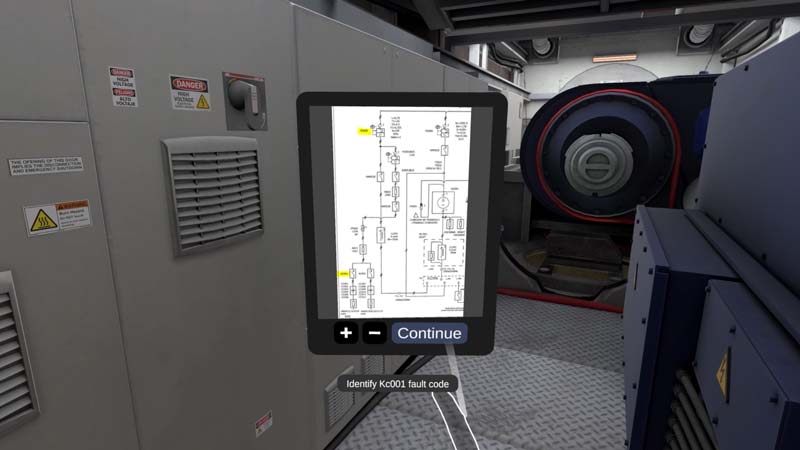
Machine-specific energy isolation: identify every energy source, apply locks and tags in sequence, verify zero energy and safely restore service. LOTO stays in OSHA's top ten because generic training fails on real equipment; VR trains the exact procedure on the exact machine.
Confined Space Entry
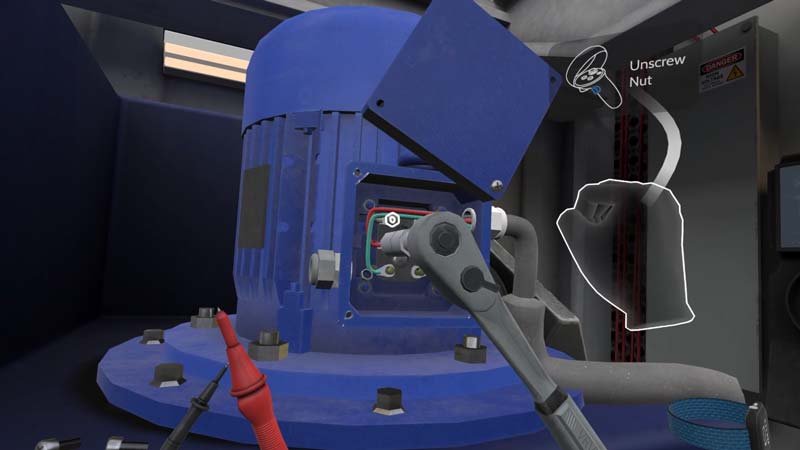
Permit-required entries, atmospheric testing, ventilation, attendant communication and rescue, inside vaults, tanks and manholes that are dangerous and expensive to use for practice. Workers rehearse the full permit process, including what to do when conditions deteriorate mid-entry.
Working at Heights & Fall Protection
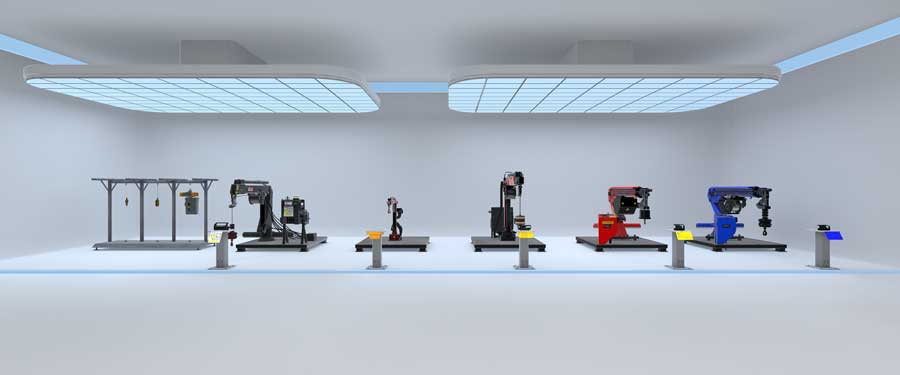
Harness inspection, anchor selection, tie-off procedures and climbing protocols, with the sense of height that makes the training stick. Fall protection has been OSHA's most-cited violation for 15 straight years; VR closes the gap without putting anyone on a real tower to learn.
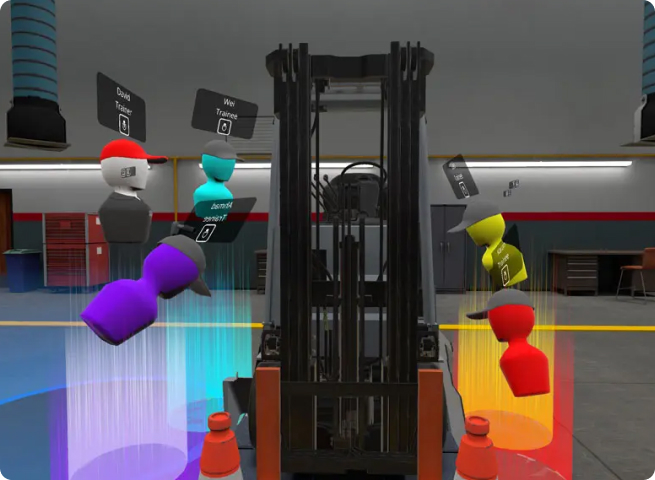
Machine Guarding & Equipment Safety
Safe operation of forklifts, presses, conveyors and production machinery: pinch points, guard verification, pedestrian awareness and load handling, in a facility replica where a collision is a lesson, not an incident report.
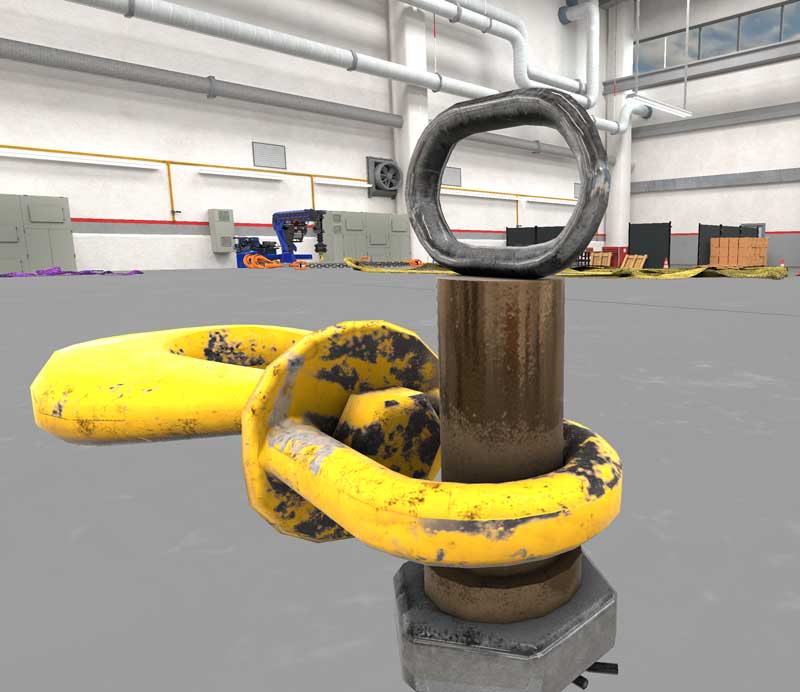
Emergency Response & Evacuation
Fire response, chemical release, evacuation routes, muster procedures and first-responder coordination under realistic pressure (smoke, alarms, blocked exits) that a walk-through drill can't replicate. Teams rehearse rare, high-severity events as often as needed.
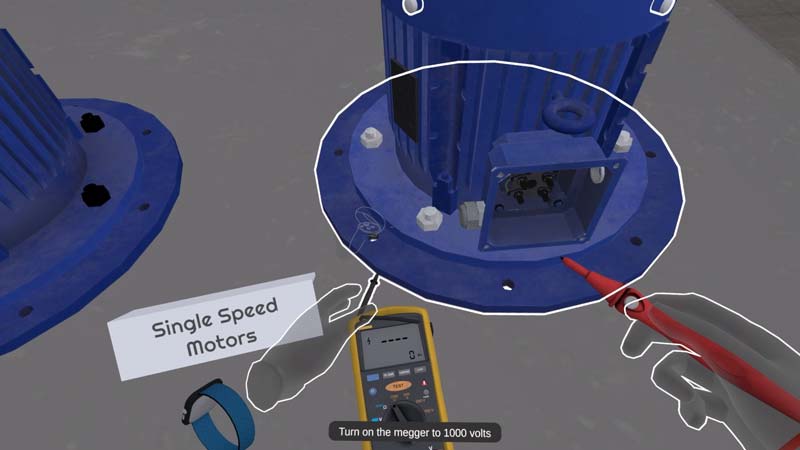
Procedural & Maintenance Safety
Complex, safety-critical maintenance sequences such as gas switching, turbine servicing and equipment changeovers become repeatable, scored simulations. Workers build muscle memory on the correct step order before touching real assets. See VR maintenance training.
Have a specific safety scenario in mind? See it as a digital twin.
Book a DemoHow Does VR Safety Training Work?
A VR safety training program has four working parts: an accurate simulation, hardware workers actually wear, a management layer that proves compliance, and the ability to train teams together.
Watch: an outdoor gas leak investigation run as a multiplayer VR scenario.
Engineering-grade replicas of your real facility
VR Vision builds each simulation from CAD models, laser scans, photogrammetry and site documentation, producing a digital twin that matches the real substation, line or turbine down to valve positions and label text. Workers train on their equipment, following their procedures, which is why the training transfers to the field.
No PCs, no cables, no dedicated lab
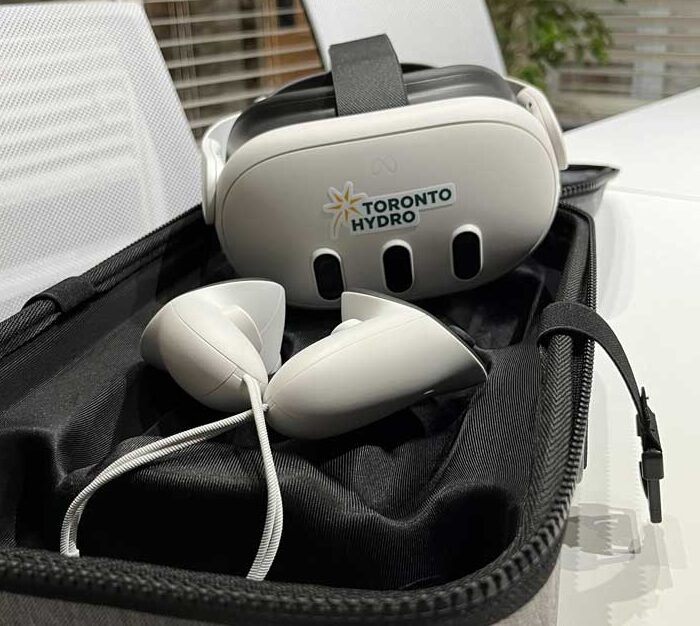
Training runs on standalone Meta Quest 3S and PICO 4 Enterprise headsets that work anywhere with a few square metres of floor space: a trades trailer, a substation office, a plant classroom. IT teams can review the XR IT security and deployment best practices for rollout guidance.
Every session measured, every step documented
Vision Portal tracks completions, scores, time-on-task and per-step performance across the workforce, giving safety leaders an audit-ready record of who trained on what, when and how they performed. Records can be exported to enterprise learning systems via SCORM and xAPI on request.
Crews train together, instructors coach live
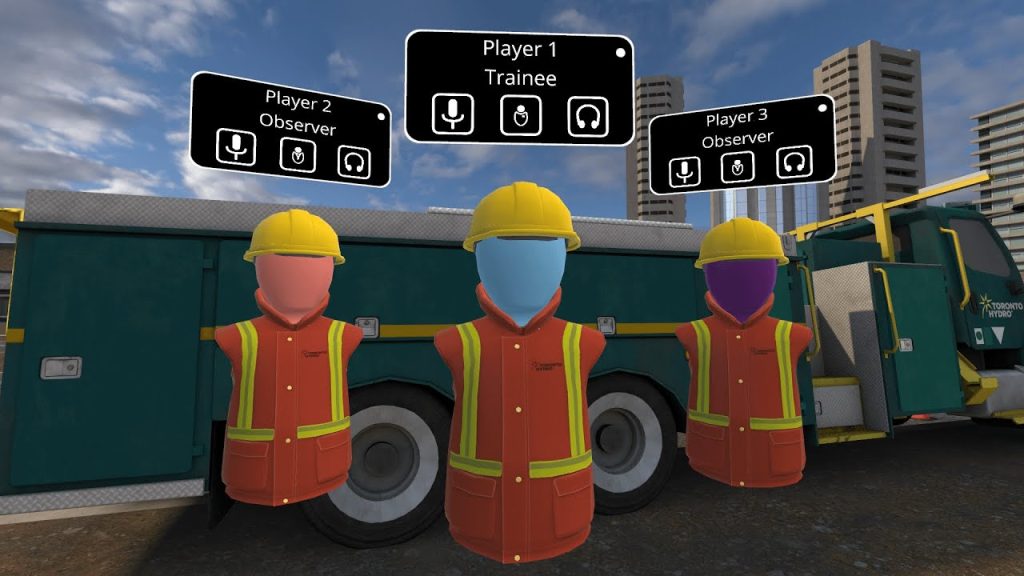
Multi-user sessions put whole crews in the same simulation, from the same room or different sites, so teams rehearse coordinated procedures like switching orders and emergency response the way they'll actually perform them. Instructors join in-headset or observe from a screen and coach in real time.
VR Safety Training vs. Traditional Safety Training
Classroom, video and live field training each have a role. Here is where VR changes the equation, and where it doesn't.
| Dimension | Traditional training | VR safety training |
|---|---|---|
| Risk exposure during training | Live-hazard practice carries real injury risk; high-risk scenarios are often skipped entirely | Zero physical risk; workers practice arc flash, confined space and heights scenarios safely |
| Repetitions per worker | Limited by equipment availability, instructor time and downtime windows | Unlimited; repeat a procedure until competency is demonstrated, not until the clock runs out |
| Equipment and production impact | Requires taking real assets out of service, travel to training sites and standby crews | Runs on standalone headsets anywhere, so assets stay in production |
| Speed to competency | Onboarding stretched across scheduled sessions and site availability | 65% faster to competency at Avangrid; 30% less time-to-train at Toronto Hydro |
| Documentation and audit readiness | Sign-in sheets, quiz scores and instructor notes; hard to prove hands-on competency | Every step scored and logged automatically per worker in Vision Portal |
| Rare, high-severity events | Nearly impossible to rehearse realistically; described, not experienced | Emergencies, failures and abnormal conditions simulated on demand, as often as needed |
| Where it falls short | Retention fades fast without hands-on practice; hard to scale consistently across sites | Doesn't replace the required hands-on practical evaluation; it prepares workers to pass it |
The honest model is blended: VR for knowledge, repetition and documented assessment, followed by a supervised practical evaluation on real equipment. That combination is what regulators accept and what safety teams trust.
Which Industries Use VR Safety Training?
VR safety training delivers the most value where hazards are severe, procedures are strict, and live practice is costly or impossible. VR Vision has spent a decade in exactly those industries.
What Results Do Companies Get From VR Safety Training?
VR Vision has trained 100,000+ workers across 100+ enterprise deployments. The outcomes below are from published client case studies, not projections.
VR training on electrical scenarios that are too dangerous or hard to stage in real life, in use for three years.
Read the Toronto Hydro case studyMaintenance crews train on substations, wind turbines and SF6 switchgear in one multiplayer VR world.
Read the Avangrid case study10,000+ dealer technicians trained on equipment and process procedures at 200+ dealerships.
Read the Toyota Material Handling case studyWatch: a VR Vision client case study.
Trusted by Toyota, Siemens Gamesa, Enel Green Power, Hydro One, Toronto Hydro, Avangrid and Coca-Cola.
Which Safety Training Metrics Should You Track?
"We did the training" isn't a metric. These are the five numbers safety and L&D leaders use to prove a VR program is working, and how each one gets measured. Model your own baseline with the ROI calculator.
Time-to-competency
Days from hire or role change to a worker's first sign-off on a safety-critical task. Avangrid technicians reached competency 65% faster with VR. Measure it before and after against your last training cohort.
First-time-right rate
The percentage of workers who execute a full procedure, every isolation step and every verification, without an error on their first scored attempt. Vision Portal captures this at the step level.
Completion and compliance coverage
The share of the required workforce with a current, documented completion on each mandated topic: the number an auditor asks for first. Automated session logs replace sign-in sheets.
Incident and near-miss trend
TRIR, near-miss reports and safety observations for trained vs. untrained cohorts over 6 to 12 months. It lags the program, so pair it with the leading indicators above.
Fully loaded cost per trained worker
Total training cost (instructor time, travel, downtime, equipment out of service) divided by workers certified. Toyota Material Handling saves $1.5M a year by training 10,000+ dealer technicians in VR instead of bringing them to headquarters.
Want a baseline for your program?
In a demo, VR Vision will map these five metrics to your highest-risk training scenarios and show you what Vision Portal reporting looks like on real data.
Map these metrics to your highest-risk scenarios.
Book a DemoHow Should You Evaluate an Industrial VR Safety Training Partner?
Most VR training vendors can build a demo. Few can pass an enterprise safety, IT and procurement review. Use these six criteria to separate a pilot toy from a program that survives an audit.
Engineering-grade digital twins
Generic 3D scenes don't transfer to the field. VR Vision builds simulations from your CAD, scans and procedures, accurate enough that training completions map to real procedural competency.
Safety-standard alignment
Modules are built against your procedures and applicable OSHA and regulatory requirements (LOTO sequences, fall protection protocols, permit processes), so VR practice reinforces the standard.
Audit-ready analytics
Vision Portal documents every session, so when a regulator or internal auditor asks who was trained and how they performed, the answer is a report, not a scramble.
Standalone, scalable deployment
Meta Quest 3S and PICO 4 Enterprise headsets deploy to any site without gaming PCs or dedicated rooms, the difference between a lab experiment and a fleet-wide program.
A decade in high-consequence industries
10+ years and 100+ deployments in energy, utilities, manufacturing and automotive. VR Vision teams have worked inside substations, plants and turbine fleets.
Enterprise IT and contractor compliance
ISN-compliant, with documented XR security and deployment practices that address device management, data handling and network requirements up front. Vision Portal offers SSO, MFA and an on-prem or air-gapped option.
How Is an Industrial VR Safety Program Delivered?
Licensed modules reach a field pilot in 1 to 2 months. Custom builds reach a pilot in 3 to 4 months. VR Vision handles content, headsets, deployment and support, so your team is not running a software project on the side.
Discovery
Pick the tasks that carry the most risk, cost or training time, and agree how success will be measured.
Build or configure
License existing modules or build custom simulations from your drawings, photos, video and work methods.
Pilot
Run the training with a real group of learners, collect Vision Portal data and refine the content with your SMEs.
Roll out and measure
Scale across sites, with completion, scores and error data tracked per learner.
Budgeting? A custom VR project typically runs $60K to $120K, and interactive 360 video runs $30K to $60K per module. Model your own payback with the VR training ROI calculator, or compare vendors with the Industrial VR Training Buyer's Guide.
Industrial VR Safety Training: Frequently Asked Questions
Does VR safety training meet OSHA requirements?
VR safety training can satisfy the training components of many OSHA standards when it covers the required content and competency is documented, but most standards also require hands-on, equipment-specific evaluation. The strongest compliance model is blended: VR for knowledge, procedure practice and documented assessment, followed by a supervised practical evaluation on real equipment. VR Vision maps each module to the client's applicable standards and produces the completion records auditors ask for.
What industrial safety topics can be trained in VR?
The most common topics are hazard recognition, electrical safety and arc flash, lockout/tagout, confined space entry, working at heights and fall protection, machine guarding and equipment operation, emergency response, and procedural maintenance safety. Any scenario that is dangerous, expensive or rare in real life is a strong VR candidate.
How is VR safety training tracked and documented?
Every session is logged automatically. Vision Portal records completions, scores, time-on-task and step-level performance for each worker, giving safety and L&D leaders an audit-ready training record across the whole workforce. Records can also be exported to enterprise learning systems using SCORM or xAPI on request.
What headsets does industrial VR safety training run on?
VR Vision programs run on standalone enterprise headsets, primarily Meta Quest 3S and PICO 4 Enterprise, with hand tracking supported. No gaming PCs, cables or dedicated training rooms are required; headsets deploy to any site with a few square metres of open floor space.
How long does a custom VR safety module take to build?
Licensed modules reach a field pilot in 1 to 2 months. Custom digital-twin builds reach a pilot in 3 to 4 months, depending on the complexity of the equipment, the length of the procedure and the quality of source material such as CAD models, scans and procedure documents. Multi-module programs are usually phased so the first module deploys while later ones are in production.
Is VR safety training effective compared to traditional methods?
In published VR Vision case studies, Avangrid technicians reached competency 65% faster than with traditional training, and Toronto Hydro cut technician time-to-train by 30%. The mechanism is straightforward: workers get unlimited hands-on repetitions of high-risk procedures that traditional training can only describe.
Does VR safety training replace hands-on field training?
No, it front-loads it. VR builds procedural knowledge, hazard awareness and muscle memory before workers touch real equipment, so field time is spent confirming competency rather than teaching basics. Most regulatory frameworks still require a practical, hands-on evaluation, and VR makes that evaluation faster and safer to pass.
How much does industrial VR safety training cost?
A custom VR project from VR Vision typically costs $60K to $120K, and interactive 360 video costs $30K to $60K per module; multi-site programs scale from there. The comparison that matters is against the fully loaded cost of live training: downtime, travel, standby crews and equipment out of production. Use the ROI calculator to model your numbers.
Can multiple workers train together in the same VR scenario?
Yes. VR Vision simulations support persistent multiplayer sessions, so full crews can rehearse coordinated procedures (switching orders, confined space entries with attendants, emergency response) in the same virtual environment from the same room or different sites, with instructors observing and coaching live.
See Your Facility in VR
Book a demo and walk through a live digital-twin safety simulation with the team that built programs for Toyota, Enel and Hydro One. VR Vision will map your highest-risk training scenarios and show you exactly what a pilot looks like.