
VR Emergency Response Training for High-Risk Scenarios
VR safety training lets crews rehearse the situations you hope never happen, such as a fire, a gas leak, a confined space rescue or an arc flash, in a realistic simulation of their own site. People build the right reactions through repetition, with zero exposure to the real hazard, and supervisors get a record of who is ready.
Why is traditional safety training not enough for high-risk scenarios?
Because the scenarios that cause the worst incidents are the ones you cannot stage for real. You cannot set a plant on fire or release gas to test a response, so most crews face their first real emergency with nothing more than a classroom session and a tabletop drill behind them.
Safety leaders tell VR Vision the same things across energy, utilities and manufacturing:
- Live drills are rare and expensive. Full-scale exercises need downtime, outside responders and weeks of planning, so they happen once a year at best.
- Knowing is not the same as doing. A worker can pass a written test and still freeze or skip a step under pressure.
- Near misses leave no practice behind. Lessons from incidents are shared as slides, not as something people can rehearse.
- Proof of readiness is thin. Sign-in sheets show attendance, not whether someone can actually perform the response.
New to the technology? Start with VR Vision's guide to virtual reality training: what it is, what it costs and how to measure results.
What high-risk scenarios can crews practice in VR?
Any emergency or high-consequence task that can be described step by step can be simulated. VR Vision builds each scenario from your own site, equipment and procedures, so the response people practice is the one they will actually use.
Emergency response drills
Alarm, evacuation, muster and first response sequences, repeated until the right actions are automatic.
Fire and gas leak response
Detect, isolate, communicate and escalate in a realistic setting, with mistakes that cost a reset instead of an injury.
Confined space entry and rescue
Permit checks, atmospheric testing, attendant roles and rescue steps practiced as a team.
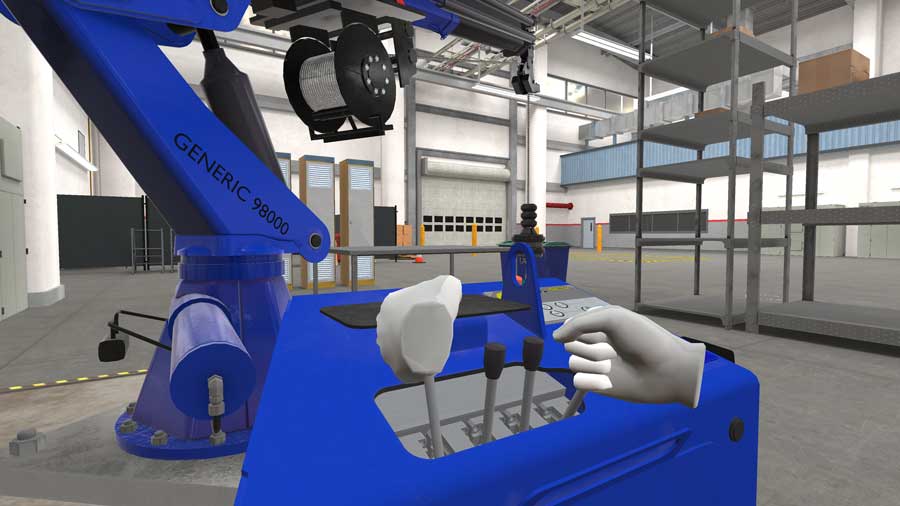
Cranes, hoists and working at heights
Lifting and rigging operations and fall hazards, the kind of training Siemens Gamesa runs in VR across its learning centres.
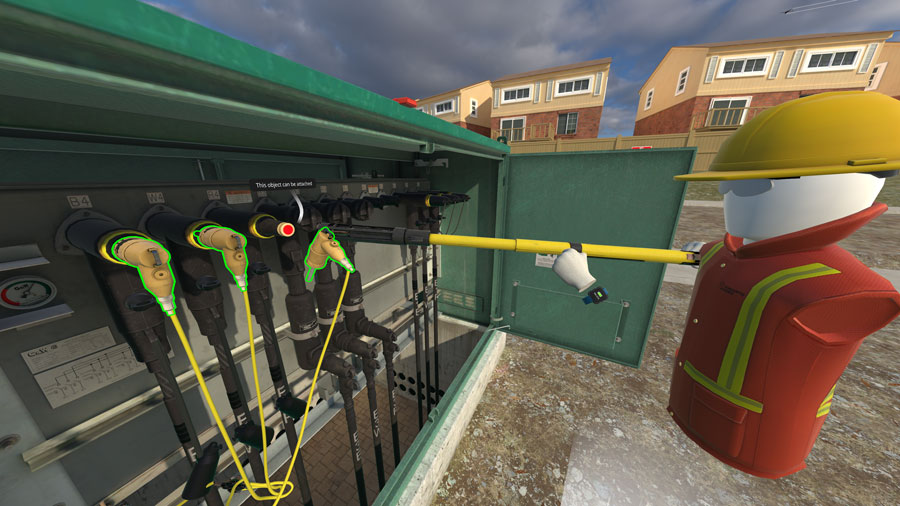
Electrical and arc flash hazards
Approach boundaries, PPE and isolation and grounding steps. For day-to-day hazard recognition, see industrial VR safety training.
Measured readiness
Every decision is logged in Vision Portal, so you can see who is ready, who needs another run and where the procedure itself breaks down.
Crews train on Meta Quest 3S or PICO 4 Enterprise headsets, with hand tracking supported. VR Vision is an authorized Meta and PICO partner, so hardware, device management and support come from one team. Sessions are tracked in Vision Portal, which supports SSO, MFA, role-based permissions and an on-prem or air-gapped option, with LMS integration (SCORM 1.2/2004, xAPI) available on request.
Watch: an outdoor gas leak investigation run as a multiplayer VR scenario.
Want to see your worst-case scenario rehearsed safely?
Book a DemoWhat results have companies seen from VR emergency training?
These figures come from published VR Vision case studies.
Three years of VR training for electrical workers on the scenarios that are most dangerous or hardest to recreate in real life, with new content added regularly.
Read the Toronto Hydro case studyOne global standard for crane and hoist training, with 9 modules from classroom basics to offshore turbines and hundreds of Meta Quest headsets deployed.
Read the Siemens Gamesa case studyHow is a VR emergency response training program delivered?
Licensed modules reach a field pilot in 1 to 2 months. Custom builds reach a pilot in 3 to 4 months. VR Vision handles content, headsets, deployment and support, so your team is not running a software project on the side.
Discovery
Pick the tasks that carry the most risk, cost or training time, and agree how success will be measured.
Build or configure
License existing modules or build custom simulations from your drawings, photos, video and work methods.
Pilot
Run the training with a real group of learners, collect Vision Portal data and refine the content with your SMEs.
Roll out and measure
Scale across sites, with completion, scores and error data tracked per learner.
Budgeting? A custom VR project typically runs $60K to $120K, and interactive 360 video runs $30K to $60K per module. Model your own payback with the VR training ROI calculator, or compare vendors with the Industrial VR Training Buyer's Guide.
VR emergency response training: frequently asked questions
What is VR emergency response training?
VR emergency response training uses virtual reality simulations to let crews rehearse emergencies and high-risk tasks in a realistic replica of their workplace. They can make mistakes and repeat scenarios without any real-world risk, and every attempt is measured.
Is VR emergency training effective?
Yes, when it is built from real procedures and measured. Toronto Hydro cut technician time-to-train by 30% with VR Vision, and Siemens Gamesa uses VR as its global standard for crane and hoist training across 10 learning centres.
What emergency scenarios can be simulated in VR?
Common scenarios include fire and gas leak response, evacuation and muster, confined space rescue, electrical and arc flash incidents, and lifting operations. Any emergency that can be written as a procedure can be simulated.
How much does VR emergency response training cost?
A custom VR project from VR Vision typically costs $60K to $120K. Interactive 360 video costs $30K to $60K per module. Licensing existing modules, where they fit, is the fastest and lowest-cost way to start.
How long does it take to launch a VR emergency training program?
Licensed modules reach a field pilot in 1 to 2 months. Custom builds reach a pilot in 3 to 4 months, depending on the number of tasks and how quickly subject matter experts can review content.
Does VR replace live emergency drills?
No. VR makes every live drill more valuable. Crews arrive having already rehearsed their roles many times, so the live exercise tests coordination instead of teaching the basics.
Rehearse your worst day, safely
Book a 30-minute demo to see high-risk scenarios built on real sites and what a safety pilot for your crews would involve.