
VR Maintenance Training for Technicians and Technical Operations
VR maintenance training lets technicians take apart, repair and troubleshoot a digital twin of your real equipment as many times as they need, without taking the asset out of service or flying anyone to a training centre. VR Vision builds these simulations for utilities, renewables, manufacturing and equipment dealer networks.
Why is maintenance training so hard to scale?
Because hands-on maintenance practice needs the equipment, the downtime and an expert trainer in the same place at the same time. That combination is expensive, so new technicians often learn complex tasks on live assets, where a mistake means damage, rework or an injury.
- Equipment cannot be spared. Pulling a production asset, turbine or switchgear line out of service for training costs output.
- Travel eats the budget. Toyota Material Handling's hands-on sessions used to require a trip to headquarters, a physical vehicle and a trainer on site.
- Rare faults are rarely seen. Technicians may go years before meeting a specific failure mode they are expected to fix.
- Expert knowledge is retiring. Senior technicians' troubleshooting know-how needs to be captured in a form others can practice.
New to the technology? Start with VR Vision's guide to virtual reality training: what it is, what it costs and how to measure results.
How does VR maintenance training work?
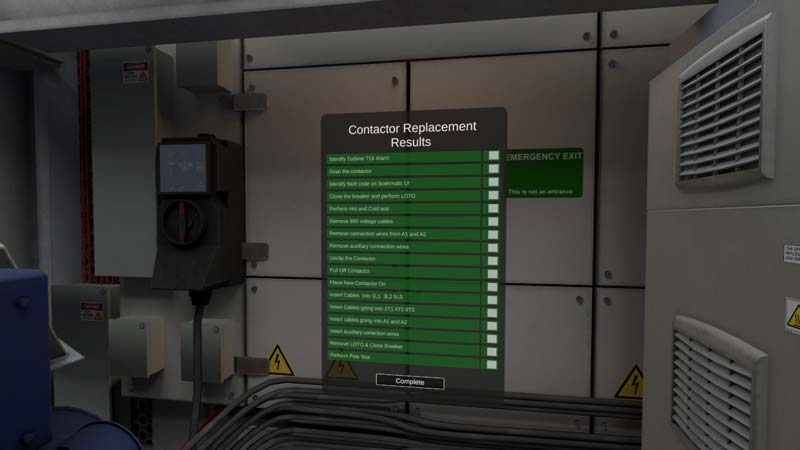
VR Vision recreates your equipment as an interactive digital twin, then scripts real maintenance procedures step by step, from lockout to reassembly and testing. Technicians use real tool motions with hand tracking or controllers, and the simulation flags wrong or skipped steps as they happen.
Guided and evaluation modes
Learners first follow a guided procedure, then repeat it unassisted in an evaluation mode that scores accuracy and time.
Troubleshooting scenarios
Inject faults on demand so technicians practice diagnosis, not just the happy-path procedure.
Multiplayer team tasks
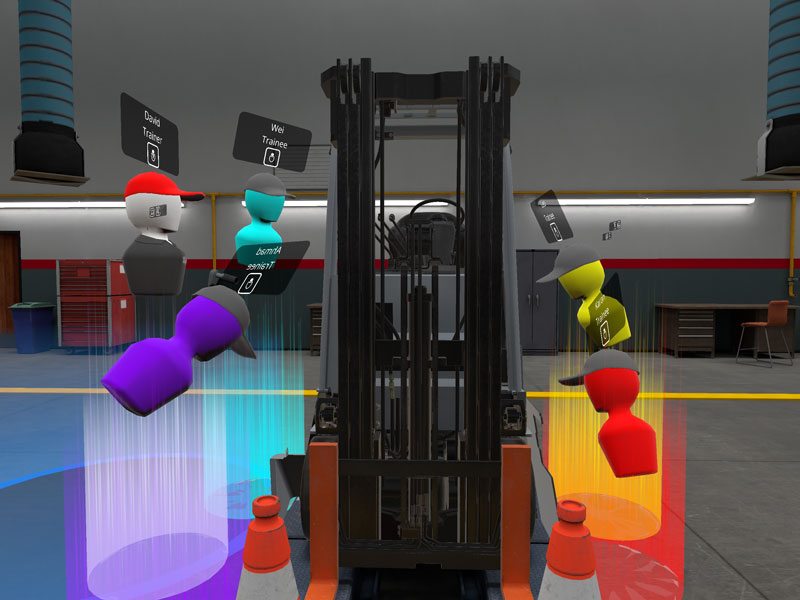
Crews train together in the same virtual space, the way Avangrid's maintenance teams do in their shared VR training world.
Component-level detail
Electrical contactors, wind turbine components or material handling equipment, modeled from your drawings, photos and manuals.
Dealer and field networks
Deploy the same program to hundreds of locations. Toyota Material Handling rolled it out to 200+ dealerships in the US and Canada.
Data for every technician
Completion, scores and error patterns in Vision Portal, with LMS reporting available on request.
Crews train on Meta Quest 3S or PICO 4 Enterprise headsets, with hand tracking supported. VR Vision is an authorized Meta and PICO partner, so hardware, device management and support come from one team. Sessions are tracked in Vision Portal, which supports SSO, MFA, role-based permissions and an on-prem or air-gapped option, with LMS integration (SCORM 1.2/2004, xAPI) available on request.
Watch: a multiplayer bucket truck aerial lift simulation.
Want to see your equipment as a VR maintenance simulation?
Book a DemoWhat results have maintenance teams seen?
These figures come from published VR Vision case studies.
Maintenance technicians onboard faster and make fewer mistakes in the field, training on substations, wind turbines and SF6 switchgear in one multiplayer VR world.
Read the Avangrid case study10,000+ dealer technicians trained across 200+ dealerships, replacing trips to headquarters with VR on 300+ Meta Quest 2 headsets.
Read the Toyota Material Handling case studyCrane and hoist training for wind turbine technicians, from classroom basics to offshore turbines, running in 10 global learning centres.
Read the Siemens Gamesa case studyHow is a VR maintenance training program delivered?
Licensed modules reach a field pilot in 1 to 2 months. Custom builds reach a pilot in 3 to 4 months. VR Vision handles content, headsets, deployment and support, so your team is not running a software project on the side.
Discovery
Pick the tasks that carry the most risk, cost or training time, and agree how success will be measured.
Build or configure
License existing modules or build custom simulations from your drawings, photos, video and work methods.
Pilot
Run the training with a real group of learners, collect Vision Portal data and refine the content with your SMEs.
Roll out and measure
Scale across sites, with completion, scores and error data tracked per learner.
Budgeting? A custom VR project typically runs $60K to $120K, and interactive 360 video runs $30K to $60K per module. Model your own payback with the VR training ROI calculator, or compare vendors with the Industrial VR Training Buyer's Guide.
VR maintenance training: frequently asked questions
What is VR maintenance training?
VR maintenance training uses a virtual reality replica of real equipment so technicians can practice inspection, repair and troubleshooting procedures hands-on. They can repeat tasks and make mistakes without damaging equipment or taking it out of service.
Can VR be used for maintenance of heavy equipment or vehicles?
Yes. VR Vision has built maintenance training for forklifts and material handling equipment for Toyota Material Handling, wind turbines for Avangrid and Siemens Gamesa, and electrical equipment for utilities. Any equipment with documented procedures can be modeled.
How much faster do technicians learn with VR?
Results depend on the task, but Avangrid's maintenance technicians reached competency 65% faster than with traditional training, and Toronto Hydro cut technician time-to-train by 30%.
How much does VR maintenance training cost?
A custom VR project from VR Vision typically costs $60K to $120K. Interactive 360 video costs $30K to $60K per module. Licensing existing modules, where they fit, is the fastest and lowest-cost way to start.
How long does it take to launch VR maintenance training?
Licensed modules reach a field pilot in 1 to 2 months. Custom builds reach a pilot in 3 to 4 months, depending on the number of tasks and how quickly subject matter experts can review content.
Will it work with our IT, security and LMS requirements?
Vision Portal supports SSO, MFA, role-based permissions and an on-prem or air-gapped deployment option. VR Vision follows ISO 27001 practices and hosts on AWS, which holds the relevant certifications. LMS integration through SCORM 1.2, SCORM 2004 or xAPI is available on request.
Turn your equipment into a training simulator
Book a 30-minute demo to see maintenance simulations built on real equipment and what a pilot for your technicians would look like.