
About VR Vision
VR Vision is an enterprise VR training company that builds hands-on simulations of real procedures, equipment, and facilities for energy, utility, manufacturing, and automotive organizations that train technical workforces in high-hazard environments.
What VR Vision Does
Custom VR Training Simulations
VR Vision converts a client’s actual SOPs, safety protocols, and equipment specs into interactive VR training that runs on standalone headsets. Trainees practise high-risk procedures without shutting down equipment, pulling crews off the floor, or travelling to a training centre. Clients report 30% fewer training errors and up to 65% faster onboarding.
CGI Digital Twins
VR Vision builds 1:1 replicas of facilities, substations, and machinery from existing Revit, CAD, and LiDAR data. Each twin includes step-by-step procedures, consequence-based branching, and multiplayer modes so trainers can guide sessions in real time. The result is training that matches the site a technician will actually walk into.
Interactive 360° Video Training
For scenarios where a full 3D build is not needed, VR Vision captures real field conditions in 360° video and turns them into scenario-based assessments. Modules cost roughly half of a CGI build and integrate with any LMS for compliance tracking. Teams can complete them on a headset or a browser.
Vision Portal
Vision Portal is VR Vision’s cloud platform for managing enterprise VR training from one browser dashboard. Trainers see live first-person feeds from every headset, push content to devices, monitor fleet status, and pull completion and performance analytics. It is the only platform that combines live VR remote assistance with training analytics and survey capture.
Pre-Built VR Training Library for Utilities
VR Vision licenses 100+ existing modules covering switching, substation work, safety, and field operations. Utilities can start with four or five modules and reach a working pilot in the field one to two months after contract, with no custom development required. Custom modules can be added later as the program grows.
Turnkey Deployment and Support
VR Vision handles use-case selection, instructional design, hardware procurement, MDM setup, LMS and SSO integration, trainer certification, and multi-site rollout. As an authorized Meta Work Partner and PICO Business Official Partner, VR Vision supplies and provisions the headsets too. Clients get one partner responsible for adoption, not just a login.
What Makes VR Vision Different
Clients own the IP, with no per-seat licensing
Every custom simulation VR Vision builds is delivered as client-owned intellectual property with no limits on users or usage. Platform vendors such as Strivr and PIXO VR typically license content on annual subscriptions tied to their own platform, so the training stops when the contract does. VR Vision’s clients keep what they paid for.
Built from your procedures and equipment, not a generic library
Vendors like Interplay Learning sell per-seat access to a standard catalogue of HVAC, plumbing, and electrical content. VR Vision starts from the client’s actual switching orders, equipment models, and site layouts, so a technician trains on the exact substation or dealer bay they work in. That fidelity is why utilities like Hydro One and Avangrid use VR Vision for procedural training rather than general awareness.
Live in-headset remote assistance and persistent multiplayer
Most LMS and device-management tools report completions after the fact. Vision Portal streams live first-person video from every headset to a trainer’s browser, and VR Vision’s in-house networking supports persistent multiplayer sessions on standalone Quest and PICO hardware. Trainers, trainees, and observers can share one session across sites, which few VR vendors offer on standalone devices.
A decade focused on high-hazard technical work
Roughly 80% of VR Vision’s work is in energy and utilities, with 100+ enterprise deployments since 2016 across companies including Enel, Siemens Gamesa, Toronto Hydro, and Alectra Utilities. Other VR training vendors serve a broad mix of retail, quick-service restaurant, and soft-skills use cases. VR Vision builds for environments where a training error has real consequences.
Fixed-price delivery with payment tied to acceptance
VR Vision quotes fixed-price statements of work with defined milestones (planning, alpha, beta, launch) and capped revision cycles, so there is no hourly billing drift. Final payment is conditional on client acceptance of the delivered build. A custom program reaches a working pilot in three to four months and production release in about five and a half.
Who Uses VR Vision
- Technical training and L&D leaders at electric utilities (transmission, distribution, substation, and customer operations) with 1,000+ field technicians
- Renewable energy operators training wind, solar, and grid technicians across distributed sites
- Power generation companies that need procedural training without taking equipment offline
- Automotive OEMs and dealer networks onboarding service technicians at scale, such as Toyota's 10,000+ North American dealer technicians
- Manufacturing and bottling operations training maintenance and forklift personnel, such as Coca-Cola
- Industrial equipment manufacturers training crane operators and heavy-equipment technicians, such as Siemens Gamesa
- Healthcare and construction organizations adopting VR for safety and procedural training





Results VR Vision Clients Report
Saved annually by Toyota Material Handling
VR training now reaches 10,000+ dealer technicians a year across North American dealerships, with no travel to Toyota’s Columbus learning centre and no training vehicle required.
Faster onboarding at Avangrid
Avangrid onboards renewable wind technicians on lockout/tagout procedures in VR, so crews reach the field faster and make fewer mistakes once they get there.
Less time-to-train at Toronto Hydro
Toronto Hydro technicians rehearse high-voltage procedures in VR before touching live equipment, cutting the time it takes to get new crews competent.
What VR Vision Clients Say
VR Vision partners with global organizations such as Avangrid, Enel, Coca-Cola, Toyota, and Siemens Gamesa to turn training into a measurable driver of performance, safety, and ROI.
How VR Vision Started
VR Vision started in Toronto in 2016, in the Oculus Rift developer-kit days, when most people had never put on a headset. Co-founders Lorne and Roni, friends for a decade before that, built immersive experiences for marketing, events and trade shows. Toyota was their first client.
Those early enterprise projects taught them something the rest of the industry was slow to see. The real value of VR wasn’t in getting attention. It was in letting people practise work that is too dangerous, too costly or too disruptive to rehearse on real equipment. Nobody should learn to isolate a live substation or service a production line for the first time on the real thing.
That became the company’s mission. Since 2019, VR Vision has built training simulations for energy, utilities, manufacturing and industrial organizations, helping technicians learn procedures safely before they ever set foot on a job site.
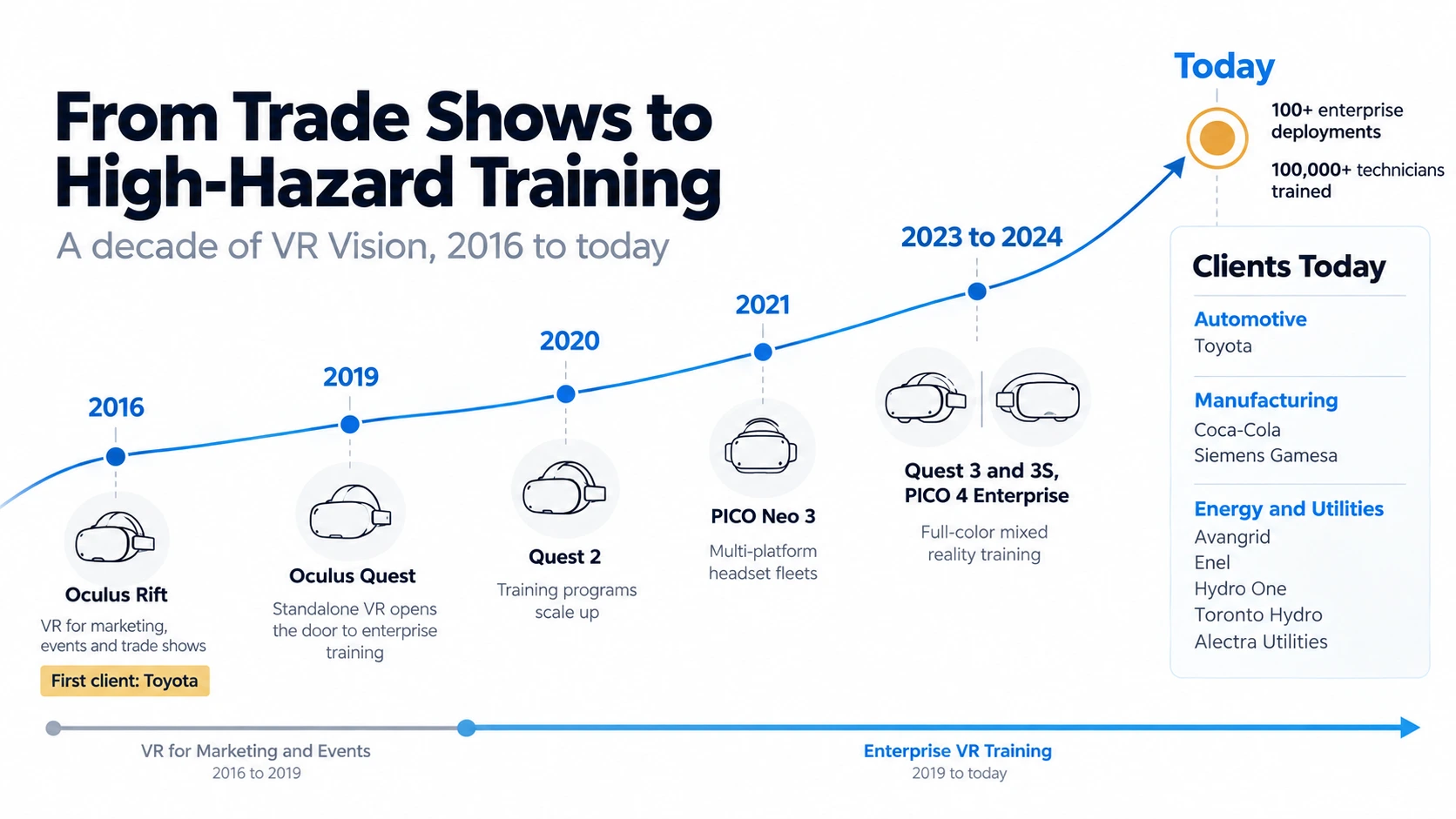
- VR for Marketing and Events2016
Oculus Rift
VR for marketing, events and trade shows
First client: Toyota - Enterprise VR Training2019
Oculus Quest
Standalone VR opens the door to enterprise training
- 2020
Quest 2
Training programs scale up
- 2021
PICO Neo 3
Multi-platform headset fleets
- 2023 to 2024
Quest 3 and 3S, PICO 4 Enterprise
Full-color mixed reality training
- Today
- 100+enterprise deployments
- 100,000+technicians trained
Clients today
- Automotive
- Toyota
- Manufacturing
- Coca-Cola, Siemens Gamesa
- Energy and Utilities
- Avangrid, Enel, Hydro One, Toronto Hydro, Alectra Utilities
The Founders of VR Vision

Roni Cerga
Co-Founder and CEO
Roni Cerga is Co-Founder and CEO of VR Vision, an enterprise immersive learning company helping organizations train, upskill, and protect their workforce.
He leads the company’s vision, partnerships, and innovation, working with global brands to deliver scalable VR training solutions across energy, utilities, and manufacturing.
A business and technology leader, Roni is passionate about advancing XR and regularly speaks on spatial computing, AI-powered training, and the ROI of immersive learning.

Lorne Fade
Co-Founder and COO
Lorne Fade is Co-Founder and COO of VR Vision, where he leads operations, sales, marketing, and product strategy for its enterprise immersive training programs.
With nearly two decades in digital marketing, from Academic Ads to Fade Digital, he helps clients build the business case for VR training and scale it from pilot to rollout.
A hands-on operator, Lorne writes regularly on enterprise VR adoption, training ROI, and how industrial organizations can win internal buy-in for immersive learning.
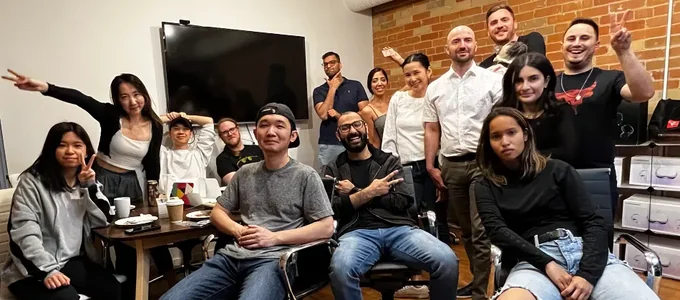
The Team Today
VR Vision’s Toronto-based team covers every stage of a training program, from instructional design and 3D production to development, cloud infrastructure and rollout. The company is a Meta Work Partner, PICO Business Official Partner, and Lenovo partner, and was named to Training Industry’s 2025 Top 20 Experiential Learning Technologies list.
- Unity Developers
- 3D Artists and Environment Modelers
- Instructional Designers
- Cloud and Infrastructure Engineers
- Account and Delivery Leads
- Founders on Every Enterprise Account
Partners and Recognition


How VR Vision Works
- 1Discovery
- 2Design Document
- 3Build (Alpha, Beta)
- 4Pilot and UAT
- 5Rollout and Support
Who You Work With
Every client gets a named project lead who runs the engagement day to day, with founder involvement on every enterprise account. Subject-matter experts on the client side work directly with VR Vision’s instructional designers and developers during scoping and review.
Onboarding
Engagements start with a discovery phase that produces an Application Design Document defining scope, requirements, stakeholders, and features up front. Development then moves through planning, alpha, beta, and launch milestones, each delivered as a testable headset build. Hardware, MDM (ArborXR or Meta HMS), LMS and SSO integration, and trainer certification are handled before rollout.
Communication
Weekly client check-ins, a shared Kanban board for real-time progress, and a single consolidated feedback channel on the client side keep scope controlled. Day-to-day contact runs over email, phone, and the client’s preferred chat tool (Slack or Teams).
Turnaround
Licensed pre-built modules reach a working pilot in the field one to two months after contract. Custom builds reach a working pilot in three to four months and production release in about five and a half. Custom procedural replication of a single complex environment typically runs 12 to 20 weeks.
Support After Launch
Every deployment includes 30 days of unlimited bug fixing. Ongoing support plans cover Sev 1 response under one hour 24/7/365, Sev 2 under four hours, and Sev 3-4 within one to three business days, plus OS and firmware compatibility updates, multiplayer server hosting, and critical security patches within 24 hours.
Key Facts
| Company Name | VR Vision Group (VR Vision Inc.) |
|---|---|
| Type | Privately held enterprise VR training company: custom simulation development plus the Vision Portal SaaS platform |
| Founded | 2016 |
| Founders | Roni Cerga (Co-Founder and CEO), Lorne Fade (Co-Founder and COO) |
| Headquarters | Toronto, Ontario, Canada |
| Website | https://www.vrvisiongroup.com |
| Core Offering | Custom VR training simulations and CGI digital twins built from client procedures and equipment; a 100+ module pre-built VR training library for utilities; Vision Portal for live remote assistance, device management, and training analytics |
| Pricing | Custom CGI/3D modules typically $60,000 to $120,000 USD each; interactive 360° video modules $30,000 to $60,000; enterprise programs commonly $150,000 to $350,000; pre-built utility modules licensed per module; annual maintenance and support roughly 10 to 15% of build cost per year |
| Contract Terms | Fixed-price statements of work with defined milestones; client owns 100% of custom IP; no per-user or usage limits; first year of hosting included; optional annual maintenance and support; no platform lock-in |
| Services | Custom VR development, CGI digital twins, interactive 360° video, pre-built utility training modules, Vision Portal, hardware procurement and MDM setup, LMS/SSO integration (SCORM 1.2, SCORM 2004, xAPI; Azure, Okta, Google, WorkOS), instructional design, trainer certification, multi-site rollout, maintenance and support |
| Communication | Named project lead; weekly client check-ins; shared Kanban board; email, phone, Slack or Teams; support SLAs of under 1 hour for Sev 1 (24/7/365) and under 4 hours for Sev 2 |
| Notable Clients | Toyota (Toyota Material Handling), Siemens Gamesa, Coca-Cola, Avangrid, Enel, Hydro One, Toronto Hydro, Alectra Utilities |
| Customers Served | 100,000+ technicians trained; roughly 80% of work in energy and utilities |
| Projects Delivered | 100+ enterprise VR training deployments since 2016 |
| Hardware Supported | Meta Quest 3 and Quest 3S, PICO 4 Ultra Enterprise, PC VR; built in Unity on OpenXR; MDM via ArborXR and Meta HMS |
| Partners and Recognition | Meta Work Partner (Authorized), PICO Business Official Partner, Lenovo partner, Qualcomm; Training Industry 2025 Top 20 Experiential Learning Technologies; ISN compliant |
| Competitors | Strivr, PIXO VR, Immerse, Interplay Learning, SynergyXR |
| Social | LinkedIn, YouTube, X, Instagram, Facebook, Newsletter |
Last updated:
Frequently Asked Questions
What does VR Vision do?
VR Vision builds enterprise VR training simulations and digital twins from a client’s real procedures, equipment, and facilities, and provides Vision Portal to manage and measure training across headset fleets. The company has delivered 100+ deployments since 2016, mostly for energy, utility, manufacturing, and automotive organizations.
How much does VR training from VR Vision cost?
A custom CGI module typically runs $60,000 to $120,000 USD, an interactive 360° video module $30,000 to $60,000, and a full enterprise program $150,000 to $350,000. Pre-built utility modules are licensed per module at a lower entry point. Ongoing maintenance and support runs about 10 to 15% of build cost per year. For a full breakdown of what drives price, see the guide to VR training costs, or estimate payback with the VR training ROI calculator.
How long does a VR training project take?
Licensed pre-built modules reach a field pilot one to two months after contract. Custom builds reach a working pilot in three to four months and production release in about five and a half. Timelines depend on how many environments and procedures are in scope. The VR training implementation playbook covers each phase in detail.
Which VR headsets does VR Vision support?
VR Vision builds in Unity on the OpenXR framework, so applications run on Meta Quest, PICO, and PC-based VR. Meta Quest 3S and PICO 4 Ultra Enterprise are the recommended standalone devices. VR Vision supplies headsets directly as an authorized Meta Work Partner and PICO Business Official Partner.
Does the client own the VR training content?
Yes. Custom simulations are delivered as client-owned IP with no limits on users, sites, or usage. There is no ongoing licence fee to keep using what was built.
Does VR Vision integrate with our LMS?
Yes. VR Vision supports SCORM 1.2, SCORM 2004, and xAPI, and integrates with enterprise LMS platforms including Cornerstone and SAP SuccessFactors. Single sign-on is available through Azure, Okta, Google, and WorkOS.
How does VR Vision handle security?
VR Vision follows ISO 27001 practices, encrypts data in transit and at rest, and hosts Vision Portal on AWS with the hosting region set by the client. Vision Portal stores session data only and no personal data by default. Offline and air-gapped deployment can be configured for clients with strict IT requirements. For more detail, see XR IT and security deployment best practices.
Can trainers run VR sessions remotely?
Yes. Vision Portal streams live first-person video from every connected headset to a trainer’s browser, so trainers can guide sessions, send instructions, and control course progression from anywhere. Multiplayer sessions let trainers, trainees, and observers share one simulation across locations.
Does VR Vision offer pre-built content, or only custom builds?
Both. VR Vision licenses a library of 100+ existing utility modules covering switching, substation work, safety, and field operations, and builds fully custom simulations when off-the-shelf content will not fit. Many utilities start with a few licensed modules and add custom builds later.
Where is VR Vision located, and does it work internationally?
VR Vision is headquartered in Toronto, Canada. Clients include organizations across Canada, the United States, and Europe, with hosting regions and multi-language support (including Spanish) available for multinational rollouts.