
VR Upskilling and Reskilling Training for Frontline Teams
VR upskilling lets frontline workers learn new equipment, new procedures and new roles by doing the work in a realistic simulation, without pulling assets out of service or waiting for a classroom seat. VR Vision builds these programs for utilities, renewables, manufacturing and equipment dealer networks.
Why is it so hard to upskill a frontline workforce?
Because frontline skills are learned hands-on, and hands-on practice needs equipment, downtime and an expert trainer in the same place at the same time. When tools, procedures and roles change faster than that setup allows, skill gaps grow and new tasks get learned on live assets.
- Roles keep changing. New equipment, digital systems and procedures mean workers need new skills every year, not once at hiring.
- Experienced workers are retiring. Their know-how needs to be captured in a form the next group can practice, not just read.
- Classroom seats are limited. Travel to a training centre and trainer availability cap how many people you can upskill at once.
- Progress is hard to prove. Sign-in sheets show attendance, not whether someone can do the task.
New to the technology? Start with VR Vision's guide to virtual reality training: what it is, what it costs and how to measure results.
How does VR upskilling work?
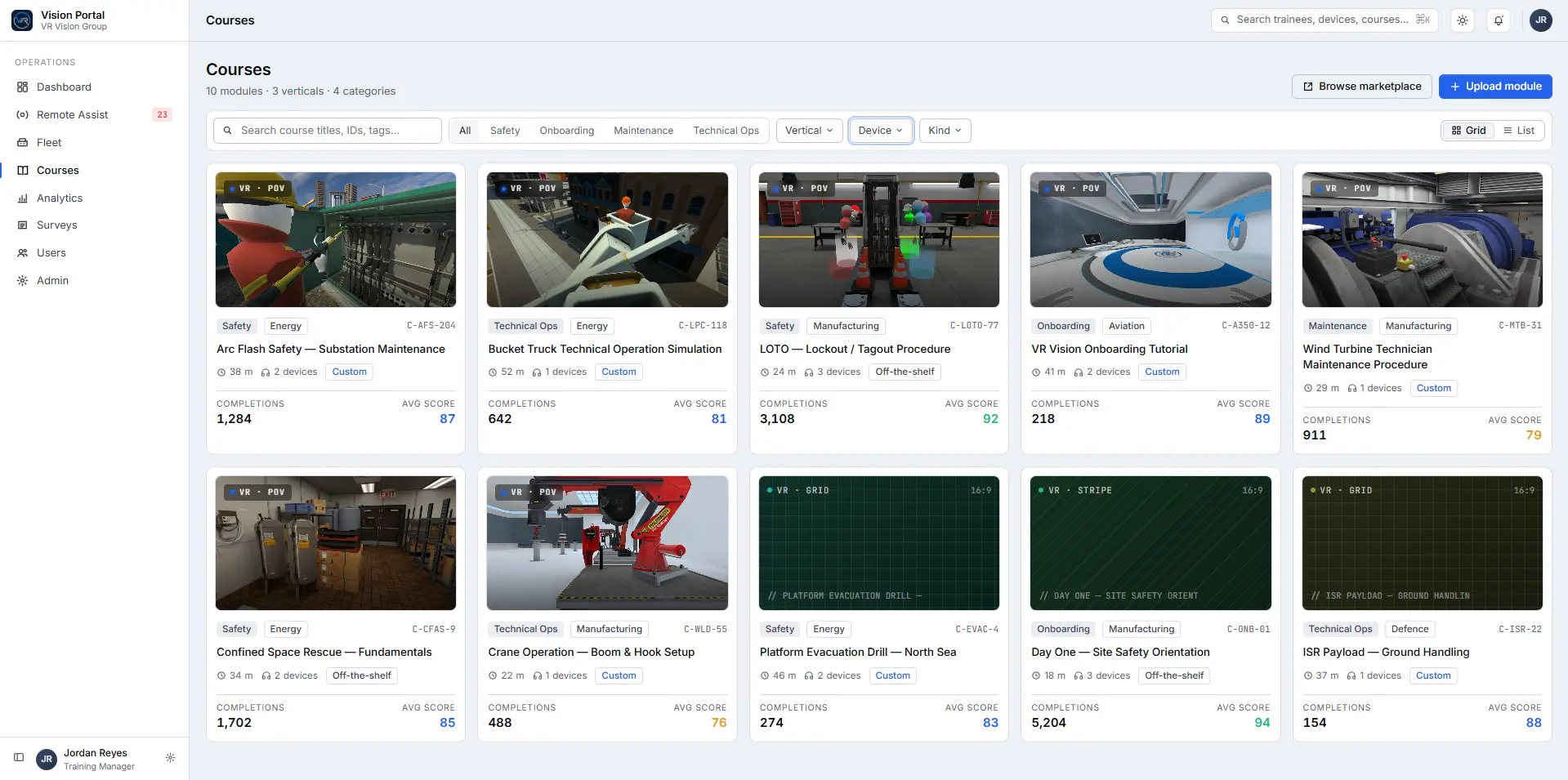
VR Vision recreates your equipment and work environments as interactive simulations, then scripts real procedures step by step. Workers learn in a guided mode, prove the skill in a scored evaluation mode, and trainers see the results in Vision Portal.
Reskilling for new roles
Move people into new jobs faster by letting them practice the core tasks of the new role before they start it.
Cross-training on equipment
Teach a new machine, tool or system without stopping production, so more of your team can cover more of the work.
Certification preparation
Rehearse certification-style tasks, like crane and hoist operation, until workers are confident before they are assessed.
Trainer-led group sessions
Instructors guide several learners through the same module in real time, watch progress and coach inside the headset.
Guided and evaluation modes
Learners follow the procedure with prompts first, then repeat it unassisted while the simulation scores accuracy and time.
Skills analytics
Track completion, scores and errors by person, role and site to find skill gaps and show time to proficiency.
Modules run on standalone Meta Quest and PICO headsets. VR Vision is an authorized Meta and PICO partner, so hardware, device management and support come from one team. Sessions are tracked in Vision Portal, which supports SSO, MFA and role-based permissions, with LMS integration (SCORM 1.2/2004, xAPI) available on request.

Watch: a multiplayer proportional valve replacement simulation.
Want to see which of your skills gaps VR could close first?
Book a DemoWhat results have workforce training teams seen?
These figures come from published VR Vision case studies.
Maintenance technicians onboard faster and make fewer mistakes in the field, training on substations, wind turbines and SF6 switchgear in one multiplayer VR world.
Read the Avangrid case study10,000+ dealer technicians trained across 200+ dealerships, replacing trips to headquarters with VR on 300+ Meta Quest 2 headsets.
Read the Toyota Material Handling case studyCrane and hoist training for wind turbine technicians, from classroom basics to offshore turbines, running in 10 global learning centres.
Read the Siemens Gamesa case studyHow is a VR upskilling program delivered?
Licensed modules reach a field pilot in 1 to 2 months. Custom builds reach a pilot in 3 to 4 months. VR Vision handles content, headsets, deployment and support, so your team is not running a software project on the side.
Discovery
Pick the skills gaps that cost the most in time, errors or risk, and agree how success will be measured.
Build or configure
License existing modules or build custom simulations from your drawings, photos, video and work methods.
Pilot
Run the training with a real group of learners, collect Vision Portal data and refine the content with your SMEs.
Roll out and measure
Scale across sites and roles, with completion, scores and error data tracked per learner.
Budgeting? A custom VR project typically runs $60K to $120K, and interactive 360 video runs $30K to $60K per module. Model your own payback with the VR training ROI calculator, or compare vendors with the Industrial VR Training Buyer's Guide.
VR upskilling: frequently asked questions
What is VR upskilling?
VR upskilling uses virtual reality simulations to teach employees new skills on digital replicas of real equipment, sites and procedures. Workers practice hands-on tasks as many times as they need, and every attempt is scored, so you can see who is ready before they do the work for real.
What is the difference between upskilling and reskilling?
Upskilling deepens skills for a worker's current role, like a technician learning a new model of equipment. Reskilling prepares a worker for a different role, like moving a plant operator into maintenance. VR supports both, because the same simulation can be assigned to anyone who needs the skill.
Can VR support certification and compliance training?
Yes. VR is a strong way to prepare for certification-style tasks. Siemens Gamesa runs nine VR crane and hoist modules as one global standard across its learning centres. VR practice supports your certification program, while final assessments still follow the rules of the certifying body.
How do you measure skill development in VR?
Vision Portal records completion, scores, time on task and errors for every learner and every attempt. Training leaders can compare results across sites and roles, spot skill gaps and show time to proficiency without adding paperwork.
Can VR training connect to our LMS?
Yes. Vision Portal supports SSO and MFA, and LMS integration with SCORM 1.2, SCORM 2004 and xAPI is available on request, so VR results sit next to the rest of your training records.
How long does it take to launch a VR upskilling program?
Licensed modules reach a field pilot in 1 to 2 months. Custom builds reach a pilot in 3 to 4 months. VR Vision handles content, headsets, deployment and support.
Close your skills gap with VR
Book a 30-minute demo to see upskilling simulations built on real equipment and what a pilot for your team would look like.