

VR training reduces on-the-job incidents not through novelty, but through repetition. Most serious workplace incidents are not caused by a lack of intelligence — they are caused by a lack of practice. A worker who has rehearsed a lockout/tagout procedure forty times in a safe virtual environment behaves very differently in the field than one who read it in a binder. That difference is where virtual reality training earns its keep — and why utilities, manufacturers, and energy companies are moving high-hazard training into immersive simulation.
The logic is simple. You cannot safely make a new technician practice an arc-flash scenario, a confined-space rescue, or an emergency shutdown on live equipment. So historically, those scenarios got taught with slides, videos, and a supervisor's verbal warning — none of which build the muscle memory that prevents panic in a real emergency. VR closes that gap. It lets people fail safely, repeatedly, until the correct action becomes automatic.
This post breaks down exactly how immersive training cuts incident rates, the mechanisms behind it, and the ten job categories where the safety payoff is largest. If you want to see the platform side of how this gets deployed and measured at scale, the Vision Portal overview is a good companion read.
Why VR Training Reduces On-the-Job Incidents
It helps to be precise about the mechanisms. "VR is more engaging" is true but not the point. The reasons immersive training lowers incident rates are concrete and measurable.
1. Repetition without real-world risk
In a high-hazard environment, you get very few live repetitions of a dangerous procedure — sometimes zero before the real thing. VR removes that ceiling. A trainee can run an emergency de-energization sequence twenty times in an afternoon, make mistakes, see the consequence, and correct it, all without exposure to live current, falling loads, or toxic atmospheres. Repetition is what converts knowledge into reflex, and reflex is what holds up under stress.
2. Realistic consequence, not abstract warning
A slide that says "always verify isolation" is forgettable. A simulation where skipping isolation produces an immediate, visible failure is not. Immersive scenarios let workers experience the cause-and-effect of an unsafe action in a way that imprints. The lesson sticks because the brain encodes it as something that happened, not something that was read.
3. Standardized competency regardless of trainer or location
Field training quality varies wildly depending on who is running it and how busy they are that week. A VR module delivers the exact same scenario, the same hazards, and the same evaluation criteria to every worker, whether they are in Toronto or Texas. This is the principle behind VR Vision's work with Toronto Hydro, where high-voltage hazard recognition was deployed organization-wide so competency no longer depended on instructor availability.
4. Measurable error tracking and after-action review
This is the part most people underestimate. When training happens in simulation, every action is data. You can see who hesitated, who skipped a step, who made the same procedural error twice. That turns safety training from a compliance checkbox into a genuine risk-management tool — you can identify the specific failure patterns before they reach the field. VR Vision's analytics and after-action review capabilities, delivered through Vision Portal, exist precisely for this auditing function.
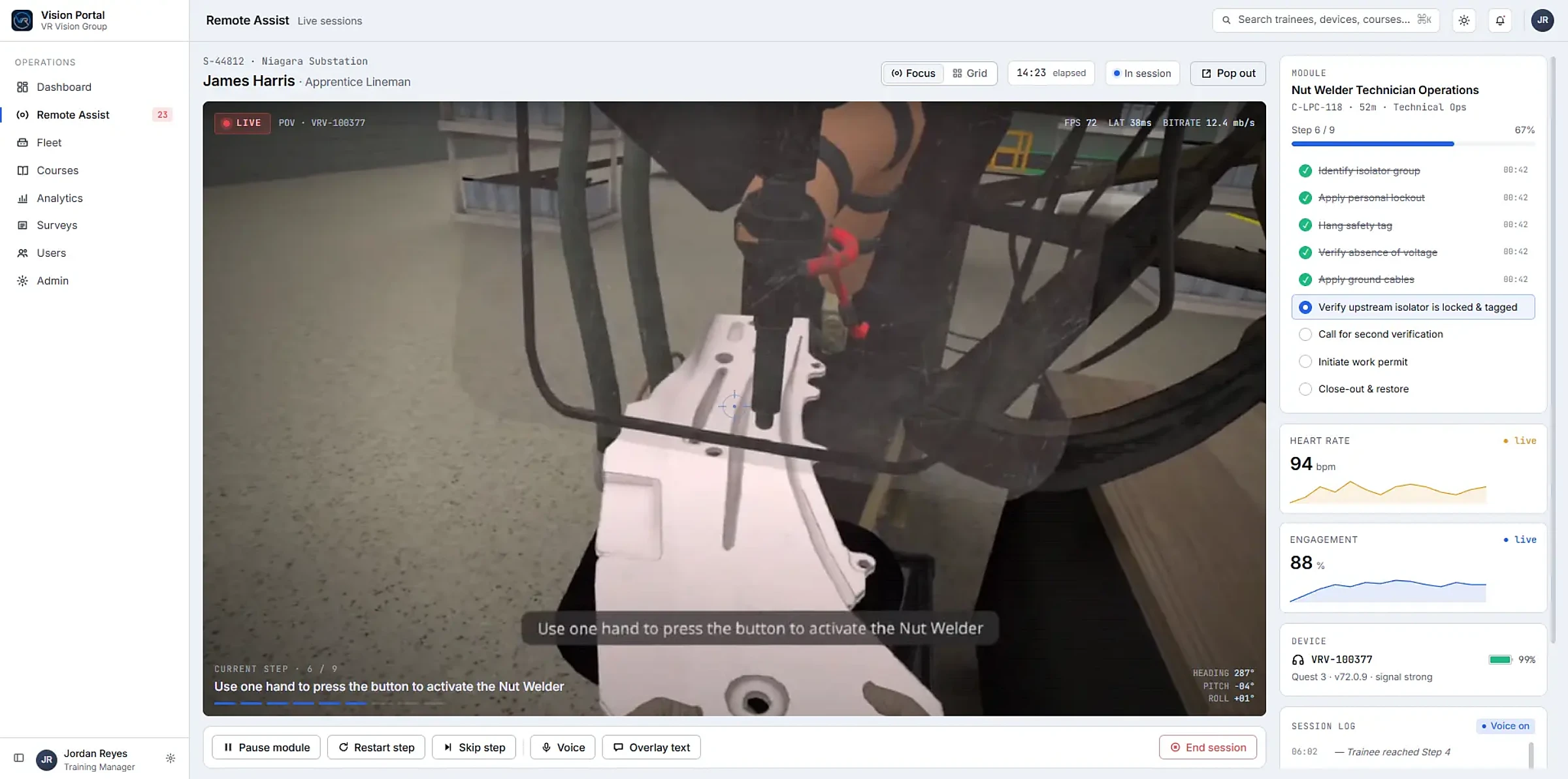
The throughline across these numbers is that faster, more standardized competency directly lowers the window in which inexperienced workers are most likely to cause incidents. Get someone to genuine competency sooner, and you shrink their highest-risk period on the job.
"If anybody is going to make immersive learning the next big thing in clean energy, it's Meta & VR Vision." — Samuel Akey, Manager, Renewables Training & Training Innovation, Avangrid
The 10 Jobs That Benefit Most From VR Safety Training
Not every role gets the same return from immersive training. The biggest safety payoff comes where three conditions overlap: the work is genuinely dangerous, the procedures are complex, and live practice is impractical or impossible. These ten job categories sit squarely in that intersection.
1 High-Voltage Electrical & Substation Technicians
Arc flash, accidental energization, and improper isolation are among the most lethal hazards in any industry. You cannot rehearse these on live gear, and a single mistake can be fatal. VR lets technicians practice hazard recognition, lockout/tagout, and switching sequences on a photorealistic digital twin of their actual substation. This is the exact use case behind VR Vision's Toronto Hydro deployment, where technicians now practice critical hazard identification in a safe, repeatable virtual environment before ever entering the field. See how this maps to a full build on the VR application development page.
2 Wind Turbine & Renewable Energy Technicians
Turbine technicians work at extreme height, in confined nacelles, around high-voltage electrical systems — often hours from the nearest hospital. Training them on the physical asset is expensive, weather-dependent, and risky. VR Vision delivered immersive wind-turbine electrical troubleshooting for Avangrid, contributing to 65% faster onboarding across 50+ deployed modules. Workers learn nacelle layout, fault diagnosis, and emergency procedures before they ever clip into a harness.
3 Nuclear & High-Consequence Plant Operators
In nuclear environments, the cost of a procedural error is catastrophic and exposure time itself is a hazard to be minimized. Immersive training lets operators rehearse radiation-field procedures and emergency response repeatedly without accumulating dose. The goal here is what the industry calls zero-error operation — shortening time-to-competency without increasing exposure. This is a core focus area for VR Vision's high-consequence simulation work, including air-gapped and offline-capable deployment for security-sensitive facilities.
4 Oil, Gas & Confined-Space Workers
Confined-space entry kills workers every year, frequently because the rescue attempt itself becomes a second casualty. These scenarios are nearly impossible to drill realistically without manufacturing the very danger you are training against. VR reproduces the atmosphere monitoring, entry permits, communication protocols, and emergency egress in a controlled environment, so the procedure is automatic when it matters.
5 Manufacturing & Heavy Machinery Operators
Pinch points, lockout/tagout failures, and improper machine guarding account for a large share of plant-floor injuries. High-throughput manufacturers need to bring large workforces to competency quickly and consistently. VR Vision's work with Toyota proved the platform's stability and ability to handle process training at global manufacturing scale, with high-throughput user management — exactly the conditions where standardized, repeatable VR training prevents the shortcuts that cause incidents.
6 First Responders & Emergency Personnel
First responders must navigate complex, dangerous environments — underground transit stations, industrial sites — under extreme stress, often for the first time during the actual emergency. VR digital twins let them build cognitive familiarization with a site's layout, egress routes, and emergency systems before an incident occurs. VR Vision's first-responder familiarization work uses engineering-grade digital twins of below-ground transit environments to rehearse navigation, communication, and emergency resource location safely.
7 Transit & Rail Operations Staff
Rail and transit environments combine electrified track, moving equipment, confined platforms, and the public. Safety-critical procedures have to be drilled to the point of operational readiness without disrupting live service or putting trainees near hazards. Immersive simulation replicates constrained spaces and emergency systems with the accuracy these safety-critical deployments demand.
8 Aviation Maintenance & Ground Crew
Aircraft maintenance involves complex, high-stakes procedures where an overlooked step can have severe consequences, and where access to the physical aircraft for training is limited and costly. VR lets technicians rehearse inspection and maintenance sequences repeatedly, reinforcing procedural adherence and reducing the errors that come from unfamiliarity.
9 Construction & Working-at-Height Trades
Falls remain one of the leading causes of workplace fatalities. Fall protection, scaffolding inspection, and hazard awareness can all be rehearsed in VR with realistic height perception that flat video cannot replicate. The immersive sense of exposure is what makes the safety lesson land — trainees feel the consequence of a missed tie-off without any real risk.
10 Chemical & Hazardous Materials Handlers
Workers handling hazardous materials face exposure, spill, and reaction risks where the correct response sequence must be immediate and exact. You cannot stage a real chemical release to train against it. VR reproduces spill response, PPE protocols, and containment procedures so the response is rehearsed and reflexive before any real exposure event.
What Separates Effective VR Training From a Gimmick
Here is the honest part: not all VR training reduces incidents. A flashy demo that workers run once and forget changes nothing. The programs that actually move safety numbers share a few traits, and they are worth knowing before you invest.
Fidelity to the real environment. Generic "factory" scenarios do not build the spatial familiarity that prevents incidents. The training has to replicate the actual substation, plant, or station — which is why VR Vision builds 1:1 digital twins from clients' existing engineering data (Revit, CAD, LiDAR) rather than generic environments. "Close enough" is not acceptable when the consequence is a life.
Measurement and after-action review. If you cannot see what trainees did, you cannot identify risk patterns. The analytics layer — session tracking, error logging, completion data, path visualization — is what converts training from an event into an ongoing safety instrument. This is the function of Vision Portal, and it is the difference between hoping training worked and proving it did. The same data feeds the financial case: if you want to put numbers to it, the VR training ROI calculator estimates cost savings and productivity gains from reduced incidents and faster competency.
Enterprise deployment and device management. A pilot on two headsets is easy. Rolling out standardized training across hundreds of devices, multiple sites, and strict IT security requirements is the hard part — and it is where most VR safety initiatives stall. Proper mobile device management, offline capability, and LMS/SSO integration are what let a safety program actually reach the whole workforce rather than a lucky few.
Built for the right hardware. Standalone enterprise headsets like the Meta Quest 3S and Pico 4 Ultra Enterprise make large-scale deployment practical in a way tethered PC-VR never could. The training has to be optimized for the devices your workforce will actually wear every day.
The Bottom Line on VR and Workplace Safety
The connection between immersive training and fewer incidents is not magic — VR training reduces on-the-job incidents through repetition, realistic consequence, standardization, and measurement, applied to exactly the situations where traditional training fails. The jobs that benefit most are the ones where the work is dangerous, the procedures are complex, and live practice is impractical. For those roles, VR is not a nice-to-have. It is the only way to give workers meaningful reps at the scenarios most likely to hurt them.
If you are responsible for safety or workforce training in a high-hazard industry, the question is no longer whether immersive training works — a decade of enterprise deployments has answered that. The question is which of your highest-risk procedures you would most want your people to have rehearsed a hundred times before they face them for real. When you are ready to move from interest to rollout, the enterprise VR training implementation playbook walks through how to scope a pilot, build the internal business case, and scale across sites.
Put Real Numbers to Your Safety Case
Estimate the cost savings, productivity gains, and incident reduction VR training could deliver for your workforce.
Try the ROI CalculatorFrequently Asked Questions
Does VR training actually reduce workplace incidents?
Yes. VR training reduces incidents by giving workers unlimited safe repetitions of dangerous procedures, letting them experience realistic consequences of unsafe actions, standardizing competency across the workforce, and tracking errors so risk patterns can be caught before they reach the field. The effect is strongest for high-hazard roles where live practice is impractical.
Which industries see the biggest safety benefit from VR training?
Energy and utilities, nuclear, oil and gas, manufacturing, transit and rail, aviation, construction, and hazardous-materials handling see the largest benefit. These sectors combine genuine danger, complex procedures, and environments where training on live equipment is unsafe or impossible.
How is VR safety training measured?
Through analytics platforms like Vision Portal, which log session data, completion rates, procedural errors, navigation paths, and after-action review. This turns training into a measurable risk-management tool rather than a compliance checkbox.
What hardware is used for enterprise VR safety training?
Standalone enterprise headsets such as the Meta Quest 3S and Pico 4 Ultra Enterprise are recommended for large-scale deployment, managed through mobile device management platforms for security, updates, and fleet control.