

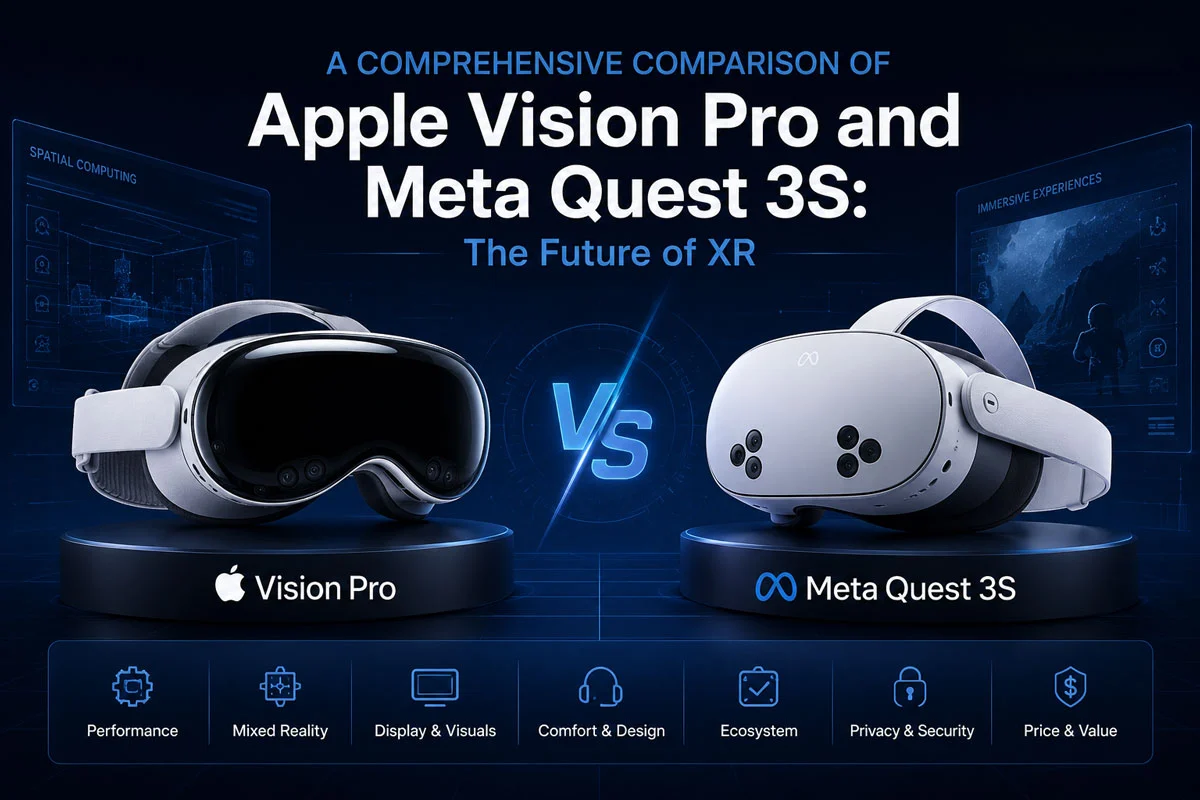
The Apple Vision Pro and Meta Quest 3 are the two headsets that defined mixed reality — but they solve very different problems. The Vision Pro is a $3,499 premium spatial computer; the Quest 3 is a $499 standalone VR headset built for scale.
For a business evaluating XR, the right pick comes down to one question: are you after the best possible image quality for a handful of high-value users, or a device you can deploy across a whole workforce? Here's how the two compare in 2026, and where each one fits in an enterprise training program.
Quick Verdict
Choose the Apple Vision Pro for premium spatial computing, design review, and visualization where display quality matters more than cost or scale.
Choose the Meta Quest 3 for fleet-scale VR training and collaboration — far lower cost-per-seat, a huge content library, and proven enterprise management.
For most enterprise training, the Quest 3 (or cheaper Quest 3S) wins on deployability. The Vision Pro is a specialist tool, not a fleet device.
Apple Vision Pro vs Meta Quest 3 at a glance
Apple Vision Pro
$3,499 (M5)
- Micro-OLED, 23M pixels — best display in class
- Apple M5 + R1 chips, 16 GB RAM
- Hand, eye & voice input (no controllers)
- visionOS 26 with on-device Apple Intelligence
- ~2–2.5 hrs on tethered external battery
Meta Quest 3
$499 (512 GB)
- LCD, 2064 × 2208 per eye, pancake lenses
- Snapdragon XR2 Gen 2, 8 GB RAM
- Touch Plus controllers + hand tracking
- Huge Quest content library + Meta Horizon management
- ~2–3 hrs on integrated battery, fully wireless

Full spec comparison (2026)
| Spec | Apple Vision Pro | Meta Quest 3 |
|---|---|---|
| Starting price | $3,499 | $499 (512 GB) |
| Category | Mixed reality / spatial computer | Standalone VR with color passthrough |
| Chipset | Apple M5 + R1 | Snapdragon XR2 Gen 2 |
| Display | Micro-OLED, 23M pixels total | LCD, 2064 × 2208 per eye |
| RAM | 16 GB | 8 GB |
| Input | Eyes, hands, voice (controller-free) | Touch Plus controllers + hand tracking |
| Battery | ~2–2.5 hrs (external pack) | ~2–3 hrs (integrated) |
| OS / ecosystem | visionOS 26, Apple ecosystem | Meta Horizon OS, large Quest library |
| Best for | Premium visualization, few users | Training & collaboration at scale |
What actually matters for business
Display vs deployability
The Vision Pro's micro-OLED display is genuinely best-in-class — 23 million pixels make fine text and CAD detail readable in a way the Quest 3's LCD can't match. But for training, deployability usually beats raw resolution. At roughly seven times the price, putting Vision Pros on a factory floor rarely makes financial sense.
Mixed reality vs virtual reality
The Vision Pro leads with mixed reality — digital content layered over your real surroundings, ideal for design review and spatial productivity. The Quest 3 is VR-first with strong color passthrough, which suits immersive training scenarios: hazard simulations, procedural practice, and confined-space drills where you want the trainee fully inside the environment.
Cost-per-seat and management
This is where the Quest 3 pulls ahead for enterprise. Meta offers business management and warranties, and the cheaper Quest 3S ($349) drops cost-per-seat further for large pilots. The Vision Pro manages through Apple Business Manager, but its price and limited industrial-training content keep it niche. For the full breakdown, see our guide to VR training costs.

Keep reading
- Best Industrial VR Headsets for Business: Top 5 Compared — the full enterprise hardware shortlist.
- Guide to VR Training Costs — what a program actually costs to build and run.
- VR Training Solutions — how VR Vision builds custom enterprise training.
- VR Training ROI Calculator — model the return for your headcount and use case.
The verdict
The Apple Vision Pro is the more advanced device and the clear winner on display quality and spatial computing — but it's a premium tool for a small number of high-value users. The Meta Quest 3 (and the budget Quest 3S) wins for enterprise training and collaboration, where cost-per-seat, content, and fleet management decide whether a rollout succeeds. For most organizations standing up a VR training program, that makes the Quest line the practical choice — with the Vision Pro a powerful addition for visualization-heavy work.
Frequently asked questions
Is the Apple Vision Pro or Meta Quest 3 better for business?
For most business training and collaboration, the Meta Quest 3 is the better fit — it costs about one-seventh the price, has a large content library, and supports fleet management for scaled deployment. The Apple Vision Pro is better for premium spatial computing, design review, and visualization where display quality matters more than cost or the number of users.
What is the price difference between the Vision Pro and Quest 3?
As of 2026, the Apple Vision Pro starts at $3,499 (M5 model) and the Meta Quest 3 starts at $499 for the 512 GB model. The Meta Quest 3S, a lower-cost option, starts at $349. The Vision Pro costs roughly seven times more than the Quest 3.
What is the difference between mixed reality and virtual reality?
Virtual reality (VR) fully immerses the user in a digital environment, which is ideal for training simulations. Mixed reality (MR) overlays digital content onto the real world. The Apple Vision Pro leads with mixed reality and spatial computing, while the Meta Quest 3 is VR-first with color passthrough that also enables MR experiences.
Can you deploy the Apple Vision Pro across a large workforce?
It's possible — the Vision Pro supports Apple Business Manager and MDM — but rarely practical. At $3,499 per unit with a tethered battery and limited purpose-built training content, it doesn't scale economically. For workforce-wide VR training, managed Meta Quest headsets or purpose-built enterprise devices like the PICO 4 Ultra Enterprise deliver far better cost-per-seat.
Building a VR training program?
VR Vision designs and deploys enterprise VR training across energy, manufacturing, automotive, and utilities — and we'll recommend the right hardware for your use case, not just the flashiest one.
Book a Demo