

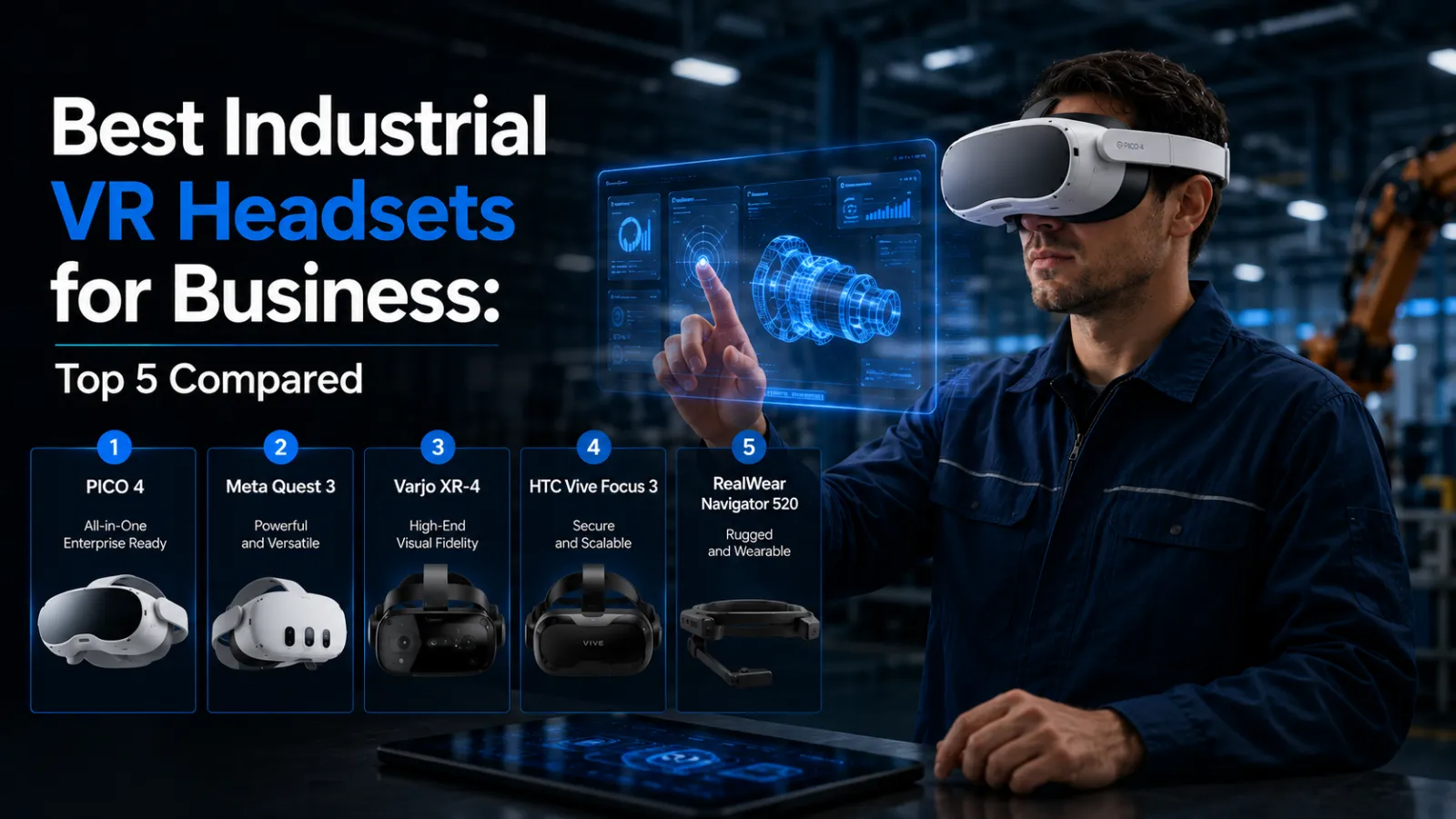
The best industrial VR headset for business right now is the PICO 4 Ultra Enterprise — it pairs a Snapdragon XR2 Gen 2 chip, 12 GB of RAM, and Wi-Fi 7 with a mature device-management layer built specifically for fleet deployment. But the "right" headset depends entirely on your use case, budget, and how many devices you need to manage at scale.
Choosing hardware for an enterprise VR training program is a different exercise than picking a headset for gaming. What matters isn't the launch-day spec sheet — it's mixed-reality fidelity for procedural training, comfort across long sessions, and whether the device plugs cleanly into a mobile device management (MDM) platform so your IT team can deploy, lock down, and update hundreds of headsets without touching each one.
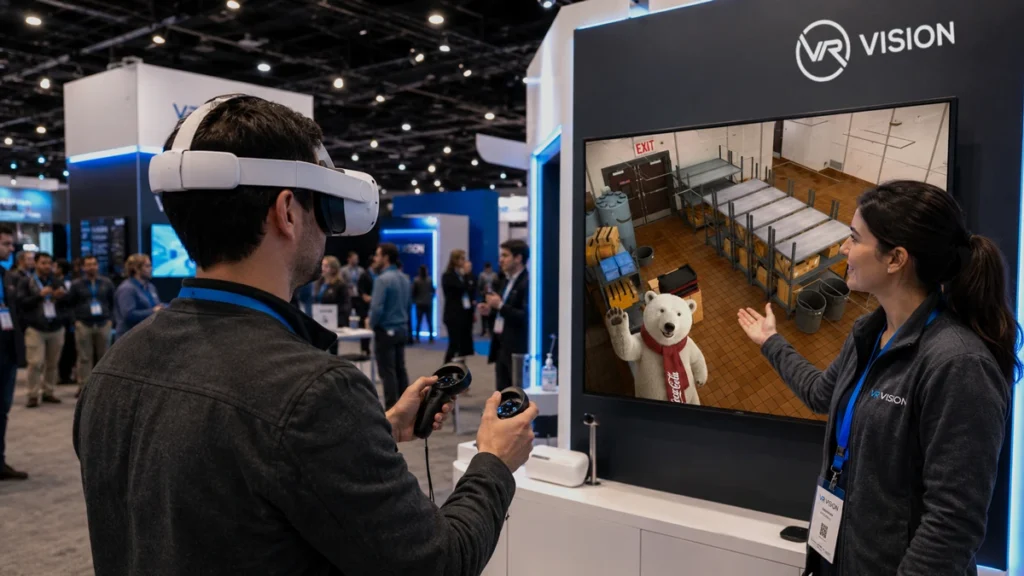
Below are the five enterprise VR headsets worth shortlisting right now, what each one is actually good for, and an honest read on the trade-offs. VR Vision deploys training on these platforms for clients including Toyota, Coca-Cola, and Avangrid, so these rankings reflect what holds up in real industrial rollouts — not lab conditions.
Quick Answer — Top 5 at a Glance
1. PICO 4 Ultra Enterprise — Best overall for industrial training; best MDM and mixed reality.
2. Meta Quest 3S — Best value; lowest cost-per-seat for large pilots (needs Meta Horizon managed services for fleet control).
3. HTC VIVE Focus Vision — Best for high-fidelity simulation; 5K resolution, eye tracking, hot-swap battery.
4. Apple Vision Pro (M5) — Best for premium spatial computing and visual fidelity; high cost, niche fit.
5. PICO "Project Swan" — Coming late 2026; a 4,000-PPI micro-OLED flagship to watch for visual-critical work.
+ AR pick: RealWear Navigator 500 — Best assisted-reality smart glasses for hands-free frontline work (a different category from immersive VR).

Enterprise VR headset comparison
Here is how the five headsets stack up on the specs that matter for industrial training deployments. Specifications reflect the business/enterprise editions where available.
| Headset | Chipset | Resolution (per eye) | RAM | Mixed Reality | Fleet / MDM | Best For |
|---|---|---|---|---|---|---|
| PICO 4 Ultra Enterprise | Snapdragon XR2 Gen 2 | 2160 × 2160 | 12 GB | Dual 32MP, ToF sensor | Native (PICO Business Suite) | Industrial training at scale |
| Meta Quest 3S | Snapdragon XR2 Gen 2 | 1832 × 1920 | 8 GB | Full-color passthrough | Meta Horizon (subscription) | Lowest cost-per-seat |
| HTC VIVE Focus Vision | Snapdragon XR2 | 2448 × 2448 (5K) | 12 GB | Color passthrough | Native (VIVE Business+) | High-fidelity simulation |
| Apple Vision Pro (M5) | Apple M5 + R1 | ~3660 × 3200 (micro-OLED) | 16 GB | High-res color passthrough | Apple Business Manager / MDM | Premium spatial computing |
| PICO "Project Swan" | Dual-chip (custom XR + SoC) | micro-OLED ~4,000 PPI | TBA | Advanced MR (TBA) | PICO ecosystem (TBA) | Visual-critical work (late 2026) |
The 5 best enterprise VR headsets for business
PICO 4 Ultra Enterprise
Best OverallBest for: Large-scale industrial and procedural training where IT needs to manage a fleet of headsets centrally.
The PICO 4 Ultra Enterprise is the headset VR Vision reaches for first on most industrial deployments, and it's widely treated as the leading enterprise VR headset available today. It's purpose-built for business: the PICO Business Suite bundles an integrated MDM solution, kiosk mode, and casting/streaming, so a single admin can deploy and lock down hundreds of devices remotely.
On raw capability, the Snapdragon XR2 Gen 2 chip, 12 GB of RAM, and dual 32MP passthrough cameras with a time-of-flight sensor give it more headroom than the Quest line's 8 GB footprint — which matters for MR multitasking, heavy training scenes, and high-fidelity digital twins. Wi-Fi 7 support cuts wireless streaming latency to roughly 5 ms, a real advantage when streaming PC-rendered content to a room full of trainees. It's also well-supported by third-party MDM platforms like ArborXR and ManageXR.
Pros
- Purpose-built enterprise OS with native MDM, kiosk mode, and remote management
- 12 GB RAM and XR2 Gen 2 — more headroom than Quest for demanding MR scenes
- Excellent mixed reality via dual 32MP cameras + ToF depth sensor
- Wi-Fi 7 for low-latency PC-VR streaming at scale
Cons
- Higher per-unit cost than consumer Quest models
- Smaller app ecosystem than Meta's consumer store
- Heavier than the Quest 3S at ~580 g
Meta Quest 3S
Best ValueBest for: Cost-sensitive pilots and large rollouts where lowest cost-per-seat is the deciding factor.
If budget is the constraint, the Meta Quest 3S is the most sensible entry point into enterprise VR today. It runs the same Snapdragon XR2 Gen 2 chip as the flagship Quest 3 and keeps full-color passthrough, but swaps pancake lenses for Fresnel and a slightly lower resolution to hit a far lower price. For training pilots where you want to put 50–100 headsets in the field without a six-figure hardware bill, the math is hard to beat.
The catch: out of the box, the Quest 3S is a consumer device. To deploy it as a managed fleet, you'll want Meta Horizon managed services (a paid layer) or a third-party MDM. It also lacks a depth sensor, which slightly softens some mixed-reality experiences. Following Meta's April 2026 price adjustments, the 3S starts at $349.99 (128 GB) — still the lowest cost of entry on this list.
Pros
- Lowest cost-per-seat of any credible enterprise option
- Same XR2 Gen 2 chip as the Quest 3
- Lightweight (~514 g) and easy for first-time users
- Largest content and developer ecosystem
Cons
- Fleet management requires a paid managed-services layer
- No depth sensor; lower resolution than Quest 3
- 8 GB RAM limits the most demanding MR scenes
HTC VIVE Focus Vision (Business Edition)
Best for FidelityBest for: High-fidelity simulation, design review, and training that depends on sharp visual detail.
The VIVE Focus Vision is the current HTC enterprise headset (the successor to the VIVE Focus 3, and the replacement for the long-discontinued VIVE Focus Plus that older guides still reference). Its standout feature is a 5K display at 2448 × 2448 per eye with a 120° field of view — the sharpest standalone image on this list — plus built-in eye tracking with foveated rendering and 26-point hand tracking.
It's a hybrid: fully standalone, but it can also stream PC-VR content over Wi-Fi 6E or a wired DisplayPort connection for graphically demanding simulations. A hot-swappable battery means you can keep sessions running without downtime — useful for continuous training-center operation. Management runs through VIVE Business+, and HTC emphasizes that its headsets meet Section 889 NDAA requirements, which matters for regulated and government-adjacent buyers.
Pros
- 5K resolution — sharpest standalone display here
- Built-in eye tracking + foveated rendering and 26-point hand tracking
- Hybrid standalone + PC-VR (Wi-Fi 6E or wired DisplayPort)
- Hot-swap battery for zero-downtime sessions; TAA/NDAA 889 compliant
Cons
- Premium price point
- ~2-hour battery per pack (mitigated by hot-swap)
- Smaller content ecosystem than Meta
Apple Vision Pro (M5)
Premium PickBest for: Premium spatial computing, design review, and visualization where image quality outweighs cost and scale.
The Apple Vision Pro sits at the top of the fidelity scale. The M5 refresh that shipped in October 2025 (still $3,499) added a faster chip, 120 Hz Mac Virtual Display, and on-device Apple Intelligence — and reviewers now consider it genuinely viable for professional work rather than a demo piece. Its custom micro-OLED display system packs 23 million pixels, delivering text and detail no standalone VR headset on this list can match.
For enterprise, it manages through Apple Business Manager and standard MDM, and developers like JigSpace are building spatial enterprise apps for design and complex-data visualization. The honest trade-offs: at roughly seven times the price of a Quest 3S, with a tethered external battery and limited purpose-built industrial-training content, it's a niche choice. VR Vision recommends it for high-value visualization and executive-facing use cases — not for putting 100 headsets on a factory floor.
Pros
- Best-in-class micro-OLED display — 23M pixels, exceptional clarity
- M5 chip with on-device AI; 120 Hz Mac Virtual Display
- Deep Apple ecosystem integration and spatial app momentum
- Manages via Apple Business Manager and standard MDM
Cons
- $3,499 — far higher cost-per-seat than any rival here
- Tethered external battery; ~750 g is heavy for long sessions
- Limited purpose-built industrial-training content
PICO "Project Swan"
Coming Late 2026Best for: Visual-critical training and design work — one to watch, not yet to deploy.
PICO previewed Project Swan in March 2026 as its next-generation flagship, targeting a global launch in late 2026. The headline is the display: micro-OLED panels at roughly 4,000 pixels per inch — about four times denser than the PICO 4 Ultra and aiming for 40–45 pixels per degree, which would effectively eliminate the screen-door effect and make fine text and CAD detail genuinely readable in-headset.
It uses a dual-chip design — custom XR silicon for perception and imaging plus a separate SoC that PICO claims delivers more than double the CPU/GPU performance of the XR2 Gen 2 — and ships on the new PICO OS 6 with broad OpenXR, WebXR, Unity, and Unreal support. For now it's a roadmap item: pricing and the enterprise edition aren't confirmed. But if your training depends on visual fidelity (detailed instrumentation, fine-print procedures, design review), it belongs on your watch list.
Pros
- ~4,000 PPI micro-OLED — likely the sharpest VR display to date
- Dual-chip architecture with 2× the compute of XR2 Gen 2
- PICO OS 6 with open standards and broad engine support
Cons
- Not yet shipping — global launch targeted for late 2026
- No confirmed pricing or enterprise edition details
- Ecosystem and MDM support still to be proven
Our AR pick: RealWear Navigator 500 for hands-free frontline work
VR and AR solve different problems. Where the immersive headsets above are built for simulation and training in a controlled space, assisted-reality smart glasses keep a worker's hands free and their eyes on the real task — guiding live work on equipment, not rehearsing it. For that job, VR Vision's AR device of choice is the RealWear Navigator 500.
RealWear Navigator 500
Assisted RealityBest for: Remote expert guidance, hands-free digital workflows, and inspections in noisy, rugged industrial environments.
The Navigator 500 isn't a VR headset — it's a rugged, voice-controlled smart-glasses device that puts a small display in the worker's peripheral vision while leaving both hands and full situational awareness intact. Frontline workers use it to connect with remote experts on live video, follow step-by-step digital work instructions, and log inspection data by voice, all without putting down a tool. Its noise-cancelling microphones are built to work in loud plants and field environments where consumer wearables fail.
It pairs with the RealWear Cloud for fleet management and an optional Teledyne FLIR thermal camera module for preventative maintenance. The Navigator 500 is RealWear's best-value model in the range; the newer Navigator 520 steps up to a brighter, sharper "HyperDisplay" if you need more screen clarity. For energy, utilities, and manufacturing clients running remote-assist and guided-workflow programs, this is the device VR Vision reaches for.
Pros
- Fully hands-free and voice-controlled — eyes stay on the task
- Rugged build with industrial-grade noise cancellation
- Hard-hat and safety-eyewear compatible for field use
- Cloud fleet management + optional thermal camera module
Cons
- Not immersive — wrong tool for simulation-based training
- Single small display, not full mixed reality
- Navigator 520 now offers a sharper display if budget allows
The headset is only one variable. After hundreds of enterprise deployments, VR Vision weighs five factors above raw specs:
1. Fleet management comes before specs
A slightly less powerful headset that your IT team can deploy, lock, and update remotely will outperform a faster device you have to configure by hand. This is the single biggest reason the PICO 4 Ultra Enterprise tops the list — native MDM is built in, not bolted on.
2. Match mixed reality to the training type
Procedural and maintenance training that overlays digital instructions on real equipment needs strong passthrough and depth sensing. Fully immersive scenarios (hazard simulation, confined-space drills) lean on resolution and field of view instead.
3. Total cost of ownership, not sticker price
Factor in management licenses, accessories (straps, cases, replacement facial interfaces), warranties, and breakage. A $349 headset with a paid management layer can cost more over three years than a purpose-built enterprise device.
4. Comfort drives completion rates
Weight distribution and battery strategy decide whether trainees finish a 45-minute module or tap out at 20. Hot-swap batteries and rear-mounted weight matter more than they look on a spec sheet.
5. Security and compliance
Regulated industries should confirm data-handling, MDM controls, and standards like NDAA Section 889 before standardizing on a device. See our XR IT & security deployment guide for the full checklist.
Keep reading
- Guide to VR Training Costs — what an enterprise program actually costs to build and run.
- The Ultimate Guide to VR Training — strategy, use cases, and rollout best practices.
- Enterprise VR Implementation Playbook — the step-by-step deployment framework.
- VR Training ROI Calculator — model the return for your own headcount and use case.
The verdict: which enterprise VR headset wins?
For most industrial training programs, the PICO 4 Ultra Enterprise is the right call — it's the most complete enterprise package, balancing strong mixed reality with the fleet-management tooling that makes a large rollout actually manageable. Choose the Meta Quest 3S when cost-per-seat is the deciding factor, the HTC VIVE Focus Vision when visual fidelity drives training outcomes, and the Apple Vision Pro for premium, visual-critical spatial computing where budget isn't the constraint. Keep PICO Project Swan on your radar for late 2026. And if the job is supporting live frontline work rather than training for it, reach for the RealWear Navigator 500 instead.
Hardware is the easy part. The programs that deliver measurable ROI are the ones where the headset choice is driven by the training objective — not the other way around. That's the part VR Vision builds with you.
Frequently asked questions
What is the difference between a VR headset and AR smart glasses for business?
VR headsets (like the PICO 4 Ultra Enterprise or Meta Quest 3S) fully immerse the user in a simulated environment and are used to train people before they handle real equipment. AR or assisted-reality smart glasses (like the RealWear Navigator 500) overlay a small display in the worker's view while keeping their hands free and eyes on the real task — used to support live frontline work such as remote expert guidance and guided inspections. Many enterprise programs deploy both.
Is the Apple Vision Pro worth it for enterprise training?
The Apple Vision Pro (M5) offers the best display quality of any headset on this list and is well-suited to premium spatial computing, design review, and high-value visualization. However, at $3,499 per unit with a tethered battery and limited purpose-built industrial-training content, it is a niche choice rather than a fleet-scale training device. For deploying many headsets on a factory floor, the PICO 4 Ultra Enterprise or Meta Quest 3S deliver far better cost-per-seat.
What is the best VR headset for business?
The PICO 4 Ultra Enterprise is the best all-around enterprise VR headset available today. It combines a Snapdragon XR2 Gen 2 chip, 12 GB of RAM, dual 32MP mixed-reality cameras, and Wi-Fi 7 with native fleet-management tools (PICO Business Suite), making it ideal for industrial training deployed at scale. For lower-budget pilots, the Meta Quest 3S offers the lowest cost-per-seat.
What is the difference between a consumer and an enterprise VR headset?
Enterprise VR headsets add device management (MDM), kiosk mode, commercial warranties, business-grade security, and dedicated support — features that let IT deploy and control a fleet of headsets remotely. Consumer headsets like the standard Meta Quest 3 can be used for business, but typically require a paid managed-services layer or third-party MDM to manage at scale.
Is the Meta Quest 3S good enough for enterprise training?
Yes, for many use cases. The Quest 3S runs the same Snapdragon XR2 Gen 2 chip as the Quest 3 and supports full-color passthrough, making it a strong, low-cost entry point for training pilots. The main limitations are 8 GB of RAM, no depth sensor, and the need for Meta Horizon managed services (or a third-party MDM) to manage a fleet.
When is the PICO Project Swan being released?
PICO previewed Project Swan in March 2026 and is targeting a global launch in late 2026. It features micro-OLED displays at roughly 4,000 PPI and a dual-chip architecture. Pricing and a dedicated enterprise edition have not yet been confirmed, so it's a device to watch rather than deploy today.
What happened to the HTC VIVE Focus Plus?
The HTC VIVE Focus Plus has been discontinued and replaced. HTC's current enterprise standalone headset is the VIVE Focus Vision (Business Edition), which offers a 5K display (2448 × 2448 per eye), built-in eye tracking, 26-point hand tracking, and a hot-swappable battery.
How many VR headsets do I need to start an enterprise training program?
Most organizations start with a pilot of 10–25 headsets to validate content and measure outcomes before scaling. The right number depends on how many trainees you need to put through per week and your session length. VR Vision's ROI calculator can help model the device count for your specific headcount and use case.
Not sure which headset fits your training program?
VR Vision designs and deploys enterprise VR training across energy, manufacturing, automotive, and utilities — and we'll recommend the right hardware for your use case, not just the newest one.
Book a Demo