
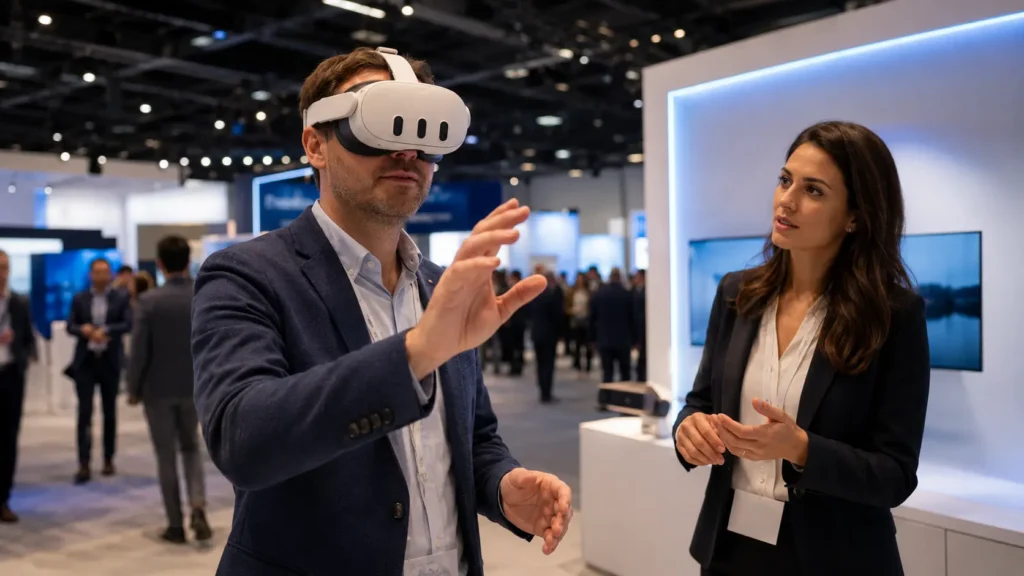
VR and AR have moved from novelty to standard playbook for brand activations at conferences, trade shows, and product launches. The shift to standalone headsets like the Meta Quest 3 and Apple Vision Pro made setup faster, throughput higher, and on-site logistics simpler. Activations now routinely deliver 2-3x booth traffic, 5-15 minute average dwell times, and significant lifts in purchase intent compared to traditional displays.
The Short Version
- VR is mainstream at events now. Most major brand activations at AWE, CES, Web Summit, Gamescom, and SXSW include some immersive component.
- Standalone is standard. Quest 3, Quest 3S, and Pico 4 Ultra dominate event deployments. Tethered PC VR is largely retired.
- Cost range: $20K turnkey 360° experiences to $250K+ fully custom interactive activations.
- Timeline: 4–6 weeks for turnkey content, 12–20 weeks for fully custom branded experiences.
- Highest-impact use cases: product immersion (cars, jets, factories), branded virtual worlds, hybrid physical-virtual experiences, and on-demand virtual showrooms.
- What's changed since 2018: AI-generated content, untethered hardware, AR through phones at scale, hybrid event formats, and Apple Vision Pro for premium experiences.
VR vs. AR: which one fits your event
Most brand activation conversations start with the wrong question — "should we use VR?" The better question is: what experience do we want the visitor to walk away with, and which technology actually delivers it?
Virtual Reality (VR)
Fully simulated 3D environment delivered through a headset. Blocks out the real world. Best for: deep product immersion, branded story experiences, training demos, and "wow factor" activations where one-on-one engagement justifies headset throughput.
Augmented Reality (AR)
Digital content overlaid on the real world via phone, tablet, or AR glasses. Best for: large-crowd activations, gamified scavenger hunts, product visualization on real surfaces, social-shareable filters, and any use case where attendees use their own devices.
Mixed Reality (MR)
Blends physical and digital content with spatial awareness — typically via Apple Vision Pro, Quest 3 passthrough, or HoloLens 2. Best for: design review, collaborative experiences, co-located physical-digital storytelling, and premium brand showcases.
Smart Glasses & Wearables
Lightweight AR delivered through devices like Ray-Ban Meta, Xreal One, Rokid AR Spatial, and Snap Spectacles. Best for: walk-up brand engagements, real-time language translation at international events, hands-free product info overlays, AI-assistant-driven activations, and content that doesn't require full immersion.
The reality is that the best activations rarely use just one. A typical large-brand booth at AWE or CES will combine an AR phone-based scavenger hunt to drive volume, smart glasses for hands-free brand engagement on the show floor, a VR headset experience for deep one-on-one engagement, and physical haptics or set design to anchor the whole thing in the real world.
Hardware for events
The hardware landscape for VR event activations looks completely different from 2018. The key shifts: standalone headsets eliminated PC tethers, pancake lenses dramatically improved image quality, sanitization workflows became standard, and Apple's entry redefined the premium tier.
| Headset | Best For | Per-Device Cost | Setup Time |
|---|---|---|---|
| Meta Quest 3 | Most brand activations, mainstream VR demos | $499 | ~5 min/unit |
| Meta Quest 3S | High-volume deployments, giveaway-friendly tier | $299 | ~5 min/unit |
| Pico 4 Ultra | Enterprise-managed deployments, larger fleets | ~$700 | ~5 min/unit |
| Apple Vision Pro | Premium luxury brand showcases, exec demos | $3,499 | ~10 min/unit |
| HTC Vive Focus Vision | Eye-tracked enterprise activations, MR demos | $999 | ~7 min/unit |
| Smartphone AR (own device) | Mass-scale activations, social-shareable filters | $0 | Instant |
The Quest 3 dominance is real
If you're planning a 10–50 headset booth deployment today, Quest 3 or 3S is almost always the right answer. The price-performance ratio is unmatched, sanitization between users is fast, the platform is mature, and the install base is large enough that you can find local support staff at most major event cities. Save the Vision Pro for tiered VIP experiences within the same activation.
10 ways to use VR and AR at your next event
The format-specific tactics have evolved, but the underlying playbook for what works at events hasn't fundamentally changed. Here's what's earning ROI right now:
1. Put visitors inside the product
The original Volvo XC90 Google Cardboard activation from 2014 set the template, and the pattern still works. Automotive, aerospace, real estate, and heavy equipment brands routinely use VR to put visitors inside their product — sitting in the driver's seat of a car they couldn't afford to bring to the show, walking the floor of a factory, touring a yacht interior. The modern version uses high-fidelity Quest 3 builds with accurate lighting, materials, and interactive feature demos.
2. Branded virtual worlds for entertainment IP
Disney, Marvel, HBO, Netflix, and game publishers regularly use VR at conventions like Comic-Con, San Diego, and Tokyo Game Show to put fans inside their IP. The modern take goes beyond passive experiences — visitors interact with characters, solve story-driven puzzles, and earn shareable digital collectibles tied back to the brand.
3. Hybrid physical-virtual activations
The biggest recent shift in event design is hybrid sets — physical environments built to match a parallel VR experience, with haptic feedback, scent, wind, temperature, and motion. Visitors don a headset and the physical room they're in becomes the digital one. Used heavily by automotive, theme park, and luxury brands for high-touch one-on-one demos.
4. Virtual venue tours and previews
Event marketers use VR pre-event to drive ticket sales — letting prospects walk through the venue virtually, meet speakers, and preview the experience before committing. Real estate, hospitality, sports venues, and convention centers use the same technique to sell future bookings.
5. AR product visualization
Furniture, automotive, fashion, and consumer electronics brands deploy AR through phone or tablet at events to let visitors see products in scale, customize colors and finishes, and visualize products in their own environments. IKEA Place, Warby Parker's virtual try-on, and Nike Fit are all variations of this pattern.
6. Gamified scavenger hunts and AR activations
Pokémon Go proved the model, and brands have adapted it for events. AR-based booth-to-booth scavenger hunts drive cross-floor traffic, lead capture, and prize-based engagement at scale. Used heavily at large trade shows where activating thousands of attendees through headsets isn't feasible.
7. On-demand virtual showrooms
For B2B brands, VR enables remote showrooms — prospects can take a 1:1 product tour anywhere in the world without travel. Common in industries with large physical products that don't ship cheaply: industrial equipment, mining, construction, marine, aerospace.
8. Hybrid live event extensions
Major product launches now routinely have a VR-attendable component for global audiences. Apple, Meta, Sony, and major automotive brands have used this format for keynote events. Vision Pro and Quest 3 attendees get a "front row" virtual seat alongside in-person attendees.
9. Branded training and recruitment activations
Career fairs, university recruiting events, and industry conferences increasingly use VR to give candidates a feel for what a job actually involves. Walmart, Verizon, Bank of America, and major utilities have all run booth-based VR job-preview activations to boost recruitment funnels.
10. AI-driven personalized experiences
The newest pattern: AI-generated experiences that personalize based on visitor input. A retail brand might capture preferences at registration, then deliver a custom in-VR product showcase tuned to that visitor's style and use case. Still emerging, but on track to be standard within 18 months.
If any of these patterns fits what you're trying to accomplish, our VR for marketing and trade shows service is built specifically for this — turnkey activation design, content production, on-site staffing, and post-event reporting.
Real-world immersive deployments worth studying
The brands earning real ROI from immersive technology are deploying it across multiple touchpoints — not just booths. Here are three patterns worth modeling, including one from our own client work.
The Coca-Cola Company — VR Sanitization Training POC
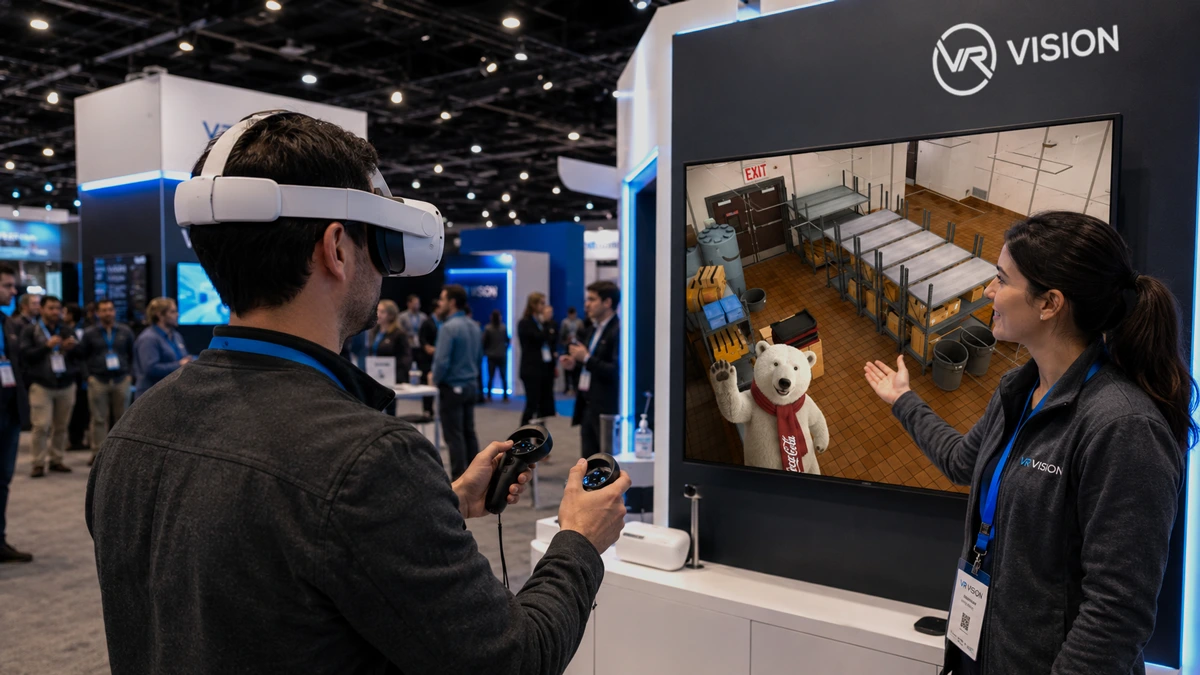
Coca-Cola partnered with VR Vision on a Quest 3-based VR training program for sanitization workflows, built as a proof of concept for broader rollout. The deliverable included a realistic digital twin of a sanitization environment with all relevant tools and equipment, plus two distinct training modes:
- Education Mode — Step-by-step guided training with visual highlights and narration, preventing mistakes to reinforce the correct workflow.
- Evaluation Mode — Trainees perform the process independently, with a controlled error tolerance before failing — reinforcing accuracy under realistic conditions.
Stakeholders flagged ease of use, visual fidelity, and instructional clarity as standout benefits in early review. The project demonstrates how immersive technology earns its place in regulated, hygiene-critical environments where mistake-tolerant practice is the entire point.
Read the full Coca-Cola case study →Vehicle configuration and immersive showrooms
Automotive brands have used VR at major motor shows to let visitors configure and "sit inside" vehicles that haven't shipped yet. The modern version typically pairs Quest 3 builds with high-fidelity interior assets and interactive feature walkthroughs. The pattern works because it solves a real logistics problem — you can't bring twelve trim variants of a flagship vehicle to a booth, but you can put each one in a headset.
Branded virtual worlds for fan engagement
Studios and game publishers regularly deploy VR at conventions like Comic-Con and Tokyo Game Show to put fans inside their properties. The strongest versions move beyond passive walkthroughs — visitors interact with characters, solve story-driven challenges, and earn shareable digital collectibles. The activation becomes a marketing asset that generates social content long after the event closes.
What VR event activations cost
Like any custom production, costs depend on scope, complexity, and how much custom branding you want vs. white-label content. Here's the realistic spread:
Turnkey 360° Experience
Pre-built or lightly-branded 360° video content delivered on Quest 3S headsets with on-site setup. 4–6 week lead time. Best for first-time activators and event-specific tactical campaigns.
Custom Branded Activation
Fully custom CG environment with branded interactivity, 8–15 headset deployment, on-site staffing, and lead capture integration. 8–14 week build. The most common activation tier for mid-size and enterprise brands.
Hybrid Physical-Virtual
Custom physical set design plus matching VR environment, haptics, scent, motion. Often includes Vision Pro tier for VIP segments. 14–20 week production. The "category-leading booth" tier — used by automotive, luxury, and entertainment IP brands.
Tour-Ready Activation
Built once, deployed across an event tour. Typical structure: $100K–$250K initial build + $15K–$40K per event for staffing, hardware, freight, and on-site production.
For a deeper breakdown of how custom VR content costs are scoped, see our VR development cost guide.
How to measure ROI on a VR event activation
The biggest mistake brands make with VR activations is treating them as creative spend rather than measurable marketing investment. Done right, an activation should produce data that proves return — and the same metrics frameworks used for digital media work here too.
The four metrics that actually matter
- Booth traffic. Count walk-by-to-stop conversion. Strong VR activations routinely double or triple stop rate vs. traditional displays.
- Dwell time. A 5–15 minute average per visitor is typical for VR vs. 30–60 seconds at a static display. Longer dwell = more brand exposure per visitor.
- Lead capture rate. Percentage of visitors who provide contact info post-experience. Well-designed activations capture 40–60% — far higher than typical booth interactions.
- Social impressions and shares. Photos and videos of visitors in headsets routinely become the most-shared content from a brand's event presence.
Major VR, AR, and XR events each year
If you're planning a brand activation or attending to scout the space, here are the events worth tracking. Full calendars at VR.org Events Calendar.
| Event | Typical timing | Usual location | Why it matters |
|---|---|---|---|
| Google I/O | May | Mountain View, CA | Android XR platform updates |
| Apple WWDC | June | Cupertino, CA | visionOS and Vision Pro updates |
| AWE USA | June | Long Beach, CA | The biggest XR conference globally |
| Immersive Tech Week | June | Rotterdam, NL | Europe's leading immersive event |
| SIGGRAPH | July or August | Rotates, North America | Computer graphics + immersive R&D |
| Gamescom | August | Cologne, DE | Largest gaming expo in Europe |
| IFA Berlin | September | Berlin, DE | Major consumer XR hardware launches |
| Tokyo Game Show | September | Chiba, JP | Japanese VR titles + PSVR2 ecosystem |
| Meta Connect | September | Menlo Park, CA | Quest hardware + Reality Labs reveals |
| Augmented Enterprise Summit | October | Atlanta, GA | Enterprise XR and digital twins |
| Web Summit | November | Lisbon, PT | Tech industry tentpole |
| CES | January | Las Vegas, NV | The marquee for new XR hardware |
Common mistakes brands make with VR at events
After a decade of running brand activations, here are the patterns I see kill ROI most consistently:
Building cool tech with no story
The activation is a means to communicate something — a product, a brand value, an experience. If your VR demo is "look how cool VR is" and not "look how this product/brand changes something," it's wasted budget. Start with the story, then back into the technology.
Forgetting throughput math
One headset can serve roughly 4-8 people per hour depending on experience length and sanitization. A booth with 4 headsets and 8 hours per day equals 130–250 visitors. If you expect 5,000 booth visitors, you need either AR for volume, multiple headsets, or shorter experiences.
Ignoring on-site staffing
You need trained staff to onboard visitors, sanitize headsets, troubleshoot issues, and manage queues. Underestimating this turns a great activation into a frustrating one. Budget for it.
No capture, no follow-up
If visitors leave without you knowing who they were, the activation generated impressions but not leads. Build email capture, QR-code-driven content, or NFC tap-to-receive directly into the experience flow.
Treating it as one-off creative
The brands that win with VR activations build assets that work across multiple events, get repurposed for digital marketing, and continue earning impressions long after the booth comes down. Plan for reuse from day one.
Planning a brand activation?
VR Vision designs, builds, and deploys immersive activations for brand showcases, trade shows, and product launches. From turnkey 360° experiences to fully custom hybrid sets — we handle the entire production, hardware, and on-site execution.
Frequently asked questions
How is VR used at events and trade shows?
Brands use VR at events for immersive product demos, virtual venue tours, training simulations, and "wow factor" activations that drive booth traffic. Common use cases include placing visitors inside a product (cars, jets, factories), virtual brand worlds for entertainment IP, hybrid physical-virtual experiences mixing haptics and VR, and AR overlays for product launches. Standalone headsets like the Meta Quest 3 and Apple Vision Pro have made deployment dramatically easier than the tethered systems of 2018-2020.
What's the difference between VR and AR for event marketing?
VR places the user in a fully simulated environment via a headset, blocking out the real world entirely. AR overlays digital content on top of the real world, typically through a phone, tablet, or AR glasses. For events, VR delivers higher immersion and a stronger "wow" factor but limits throughput (one person per headset). AR scales better for large crowds because attendees can use their own phones, and works well for product visualization, gamified experiences, and shareable social content.
How much does a VR event activation cost?
VR event activation costs typically range from $20,000 for a simple turnkey 360° video experience to $250,000+ for a fully custom CG-based interactive activation with branded environment design. Most mid-tier brand activations land between $50,000 and $150,000, including content creation, hardware, on-site staffing, and event-specific production. Hardware adds $300-3,500 per headset depending on tier.
What VR headsets work best for event activations?
The Meta Quest 3 and Quest 3S are the dominant choices for event activations today because they're standalone, fast to set up, easy to sanitize between users, and durable. Pico 4 Ultra is a strong alternative for larger deployments. Apple Vision Pro is reserved for premium brand experiences where extreme visual fidelity matters more than throughput. Cabled PC VR systems like Valve Index or HTC Vive Pro 2 are largely retired from event use due to setup complexity.
What are the major VR and AR events each year?
The major XR-focused events on the annual calendar include Apple WWDC (June), AWE USA (June), SIGGRAPH (July or August), Meta Connect (September), and Augmented Enterprise Summit (October). Major tech and trade shows with strong XR presence include CES, Web Summit, Gamescom, IFA Berlin, and Tokyo Game Show.
Can VR replace in-person event attendance?
VR doesn't fully replace in-person events but can extend their reach and accessibility. Hybrid event formats, where physical attendees experience the event in person and remote attendees join via VR, have become standard for global product launches and brand showcases. VR works particularly well for virtual showroom tours, remote demos, on-demand brand experiences, and post-event content that prospects can access asynchronously.
How long does it take to build a VR event activation?
A typical VR event activation takes 8 to 16 weeks from concept to delivery. Simple turnkey 360° experiences can be ready in 4-6 weeks. Fully custom CG activations with branded environments and bespoke interactivity require 12-20 weeks. Allow additional time for on-site logistics, hardware provisioning, and rehearsals.
What measurable ROI can brands expect from VR event activations?
Brands typically measure VR event activation ROI through booth traffic increase (often 2-3x vs. traditional displays), dwell time (commonly 5-15 minutes vs. under 1 minute for static displays), social shares, lead capture rates, and post-event content reuse. Studies cited by IPSOS and others show that AR adds up to 33% lift in product value perception, and that immersive demos can drive purchase certainty by 100%+ versus video or static product displays.
Build the activation everyone shares
From concept through on-site deployment, VR Vision builds immersive trade show and event experiences that drive booth traffic, capture leads, and produce content that earns impressions long after the show closes. Tell us where you're activating and we'll show you what's possible.