Custom VR Training vs Off-the-Shelf Content Libraries
Most enterprise VR programs stall for one reason. The organization bought the wrong category. Here are the three categories on the market, VR Vision's real pricing for each, and the single question that decides between them.
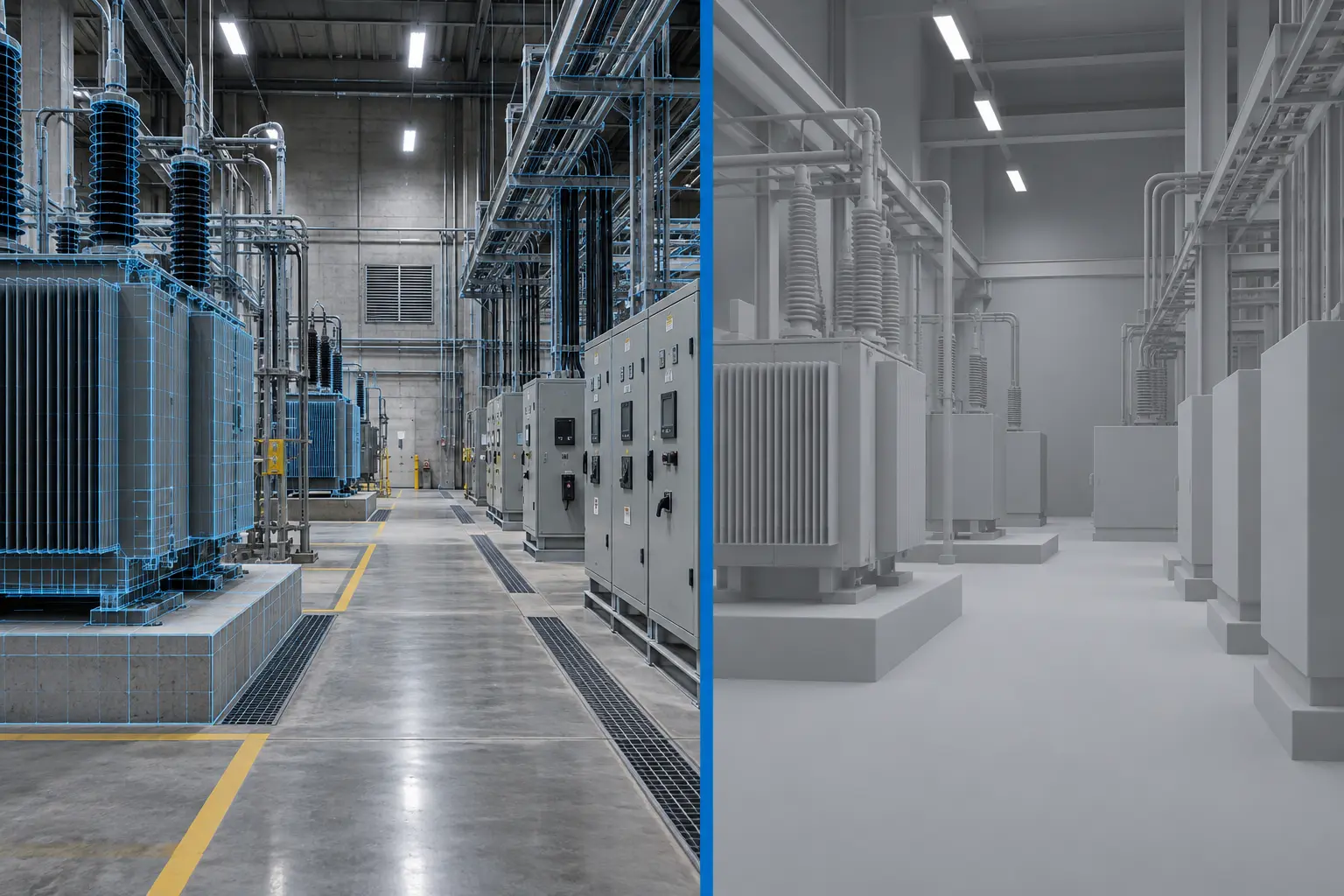
Off-the-shelf VR libraries are the right call for generic, standardized topics where any competent version of the scenario teaches the skill. Custom VR training is the right call when the trainee has to practice on a replica of their actual equipment, in their actual environment, following their actual procedure. The deciding factor is not budget or timeline. It is transfer: does the skill only transfer if the simulation matches the real asset?
The market is not a binary. It is three categories.
Almost every guide on this topic frames the decision as custom versus off-the-shelf. That framing is why so many enterprise pilots underdeliver. There are three distinct product categories, and they solve different problems.
| Category | What it is | Deploys in | Best fit |
|---|---|---|---|
| Content library | Pre-built modules licensed from a vendor catalogue. Fixed scenarios, generic environments. | 1 to 3 weeks | Compliance awareness, soft skills, standardized safety topics |
| Authoring tool | No-code software your L&D team uses to build branching scenarios, usually from 360° video or template environments. | Weeks to months, depending on internal capacity | High-volume, low-fidelity scenarios built in-house |
| Custom simulation | A digital twin of your equipment, facility and procedure, built from your CAD, Revit, LiDAR, SOPs and SME input. | 16 to 24 weeks per program | Equipment-specific, procedural and compliance-critical training |
Organizations get into trouble when they buy a library to solve a custom problem. The headsets arrive, the pilot demos well, adoption plateaus at three months, and the expansion budget never materializes. Not because VR failed, but because a technician practicing on a generic substation learns nothing transferable about the one they actually work in. The ultimate guide to VR training covers how this plays out across a full enterprise rollout.
The question that decides it
Ignore price for a moment and ask one thing:
If the simulation showed a different layout, a different control panel, or a different task sequence than the real job, would the training still work?
If yes, license a library. No digital twin is required to teach someone how to identify a hazard in principle, or how to de-escalate a conversation with an upset customer.
If no, the program needs a custom build, and buying a library first will cost more than going straight to custom. The organization pays for the library, fails to get adoption, loses twelve months of internal credibility, then has to make the custom business case anyway with a failed pilot behind it.
Choose a library when
- The topic is standardized across the industry (OSHA awareness, fire safety, general warehouse hazards)
- Headset logistics and IT security need proving before committing to a program
- The training goal is exposure and awareness, not procedural competency
- Multiple sites share genuinely identical conditions
- Budget approval this fiscal year depends on showing something live in under a month
Choose custom when
- The equipment is proprietary, modified, or unique to your sites
- The procedure is governed by your own SOP, not a published standard
- Errors in the real task carry safety, regulatory or multi-million-dollar consequences
- After-action review and procedural error logging must map to your compliance framework
- The training has to survive an audit
The hybrid path most enterprises actually take
The strongest programs do not pick one. They sequence.
Start with a licensed library for the standardized layer, which gets headsets into the field, proves the IT and MDM architecture, and builds internal familiarity at low cost. Then commission custom builds for the three to five high-consequence tasks where transfer actually matters. The library carries volume. The custom modules carry risk.
VR Vision sells both, which is why this guide is not an argument for custom. The VR training library for utilities offers 100+ existing modules covering switching, substation work, safety and field operations with no custom build required. Custom VR development is the answer when those modules do not match your assets. Most enterprise clients end up running both through the same Vision Portal deployment.
What custom VR training actually costs
Most vendors refuse to publish numbers. Here are VR Vision's real ranges for a custom enterprise engagement. Final pricing depends on scope, technical complexity and required features, and volume-based discounts apply to multi-site or multi-year deployments.
| Component | Investment (USD) | What it covers |
|---|---|---|
| Professional services | $10,000 – $30,000 | Use-case selection, instructional design, SME capture, change management, trainer certification |
| VR application development | $80,000 – $160,000 | 3D digital twin asset creation, procedural replication, interaction systems, multiplayer, knowledge checks |
| Typical full program | $150,000 – $250,000 | Professional services, digital twin creation, custom application, systems integration, year one maintenance and support |
| Multi-environment programs | Up to $350,000 | Two or more full digital twin environments with the complete platform: multi-user sessions, analytics, after-action review |
| Ongoing maintenance and support | $20,000 – $40,000 / year | Multiplayer and analytics hosting, bug fixing, annual revisions, OS updates, technical support. Year one included. |
Typical timeline for a custom program is four to six months: six to eight weeks for the digital twin environment, six to ten weeks for platform configuration and scenario development, four to six weeks for QA and user acceptance testing. SME availability is the most common cause of delay, not development. For a component-level breakdown including hardware and MDM, see the guide to VR training costs.
One line in that table matters more than most buyers realize at signature: who owns the content. A library licence is an operating cost that recurs forever and produces no asset. A custom build is a capital asset. VR Vision clients own the IP outright, with no limits on users or usage.
What happened when these organizations chose custom
Virtual reality is a huge step forward for our already best-in-class training program. If anybody is going to make immersive learning the next big thing in clean energy, it's Meta and VR Vision. Samuel Akey, Manager, Renewables Training & Training Innovation, Avangrid
Each of these programs required a digital twin. Toyota's dealer technicians train on Toyota equipment. Siemens Gamesa crane operators train on the crane configuration used across ten global learning centers. Toronto Hydro's hazard recognition platform was built from the utility's own engineering data to replicate its substations and underground environments. None of that is available in a catalogue.
Five questions to ask any VR training vendor
- Who owns the finished content, and what happens if we stop paying? Licence models end with the buyer owning nothing.
- Can you build from our CAD, Revit or LiDAR data? A vague answer means the vendor is repackaging templates.
- What happens when our SOP changes in month 14? Get the revision allowance in writing.
- What does the analytics layer actually record? Completion tracking is table stakes. Procedural error logging, session playback and after-action review are what satisfy an auditor.
- Show us a deployment at our scale in our industry. Not a demo reel. A named client, a headcount, and a number.
Frequently asked questions
How much does custom VR training cost?
A custom VR application from VR Vision runs $80,000 to $160,000. A full program including professional services, digital twin asset creation, systems integration and year one support typically lands between $150,000 and $250,000. Multi-environment programs reach $350,000. Ongoing maintenance and support is $20,000 to $40,000 per year after year one.
Is custom VR training worth it for a single site?
Usually yes if the task is high-consequence, because the cost of one avoided incident typically exceeds the build cost. It is usually not worth it for general awareness training at a single site, where a library licence does the same job for a fraction of the investment.
Can off-the-shelf VR content be customized?
Lightly. Most vendors allow branding, logo placement and translation. Changing the environment geometry, the equipment model or the task sequence is not customization, it is a rebuild.
How long does a custom VR training module take to build?
Four to six months for a typical enterprise program: six to eight weeks for the digital twin environment, six to ten weeks for platform configuration and scenarios, four to six weeks for QA and user acceptance testing. SME availability is the most common cause of delay.
Do we need custom content if we already have an LMS?
Those are different layers. The LMS assigns and records training. The VR content is what the trainee does. Custom VR simulations from VR Vision integrate with Azure, Workday, Cornerstone and other enterprise systems through SSO and LMS connectors.
What is a digital twin in VR training?
A geometrically accurate virtual replica of a real facility, asset or piece of equipment, built from engineering data such as Revit models, CAD files or LiDAR scans, so that what the trainee sees in the headset matches what they will see on site. See the digital twins overview for detail.