

360 Video Production for VR Training
VR Vision films your real sites, equipment and people in stereoscopic 360° with spatial audio, then produces footage that plays on standalone VR headsets. Crews see the real place, hear the real sounds and meet the real people before their first day on site.
Trusted by leaders in energy, utilities and manufacturing







What Is 360 Video Production?
360 video production is the process of filming a real location with a multi-lens camera that records every direction at once, then stitching, editing and sound-designing that footage so a viewer in a VR headset can look anywhere. For training, it places crews inside the real site, with the real people and sounds, before they ever set foot there.
When 360 video is the right tool
- See the site before you're thereOrientation, walkthroughs and hazard recognition in the actual environment.
- Practice real conversationsCustomer care, field service and soft-skill scenarios with real people on camera.
- Get to launch fasterReal footage skips 3D modeling, so a simple video can be ready in days to weeks.
How Hydro One trains customer care and field service teams in 360° VR.
The Fastest Way to Put Crews On Site
When trainees see the actual site and hear from the actual people, there's nothing to imagine and less to translate on the job.
Real places, real people
Footage of your own site, crews and customers creates a strong sense of presence, especially for people-focused training like customer care and field service.
Fast to produce
There's no 3D modeling. A simple 360 training video can be produced in a few days to a few weeks. Heavy graphics or sound design add time.
About half the cost of CGI
At $30K to $60K per module, interactive 360 video runs about half the cost of a custom 3D build, so the same budget covers more scenarios.
It's a game-changer that will start to unlock a simple and easy experience for customers looking to connect with Hydro One's services.Teri FrenchExecutive Vice President, Operations and Customer Care, Hydro One
What VR Vision delivered
- Stereoscopic 360° video on the Insta360 Pro 2
- GoPro point-of-view shots for close-up work
- Individual mics plus spatial audio capture
- Integrated with Hydro One's LMS to track progress
Cameras and Audio Built for Presence
Immersion comes from depth, detail and sound working together. Each shoot combines three kinds of capture.
Up to 11K, in stereoscopic 3D
Professional multi-lens rigs capture up to 11K resolution and can record a separate image for each eye for real depth. Footage is stitched into one seamless sphere, with stabilization for smooth playback.
Point-of-view close-ups
A synchronized GoPro captures the technician's own view, so learners can see the fine detail of close-up work.
Spatial audio
Ambisonic and binaural audio place each sound where it happens in the scene, while individual mics keep dialogue clear.


One panoramic image
Lower cost to produce. A good fit when depth matters less than coverage, like walkthroughs and orientation.

A separate image for each eye
Real depth and a stronger sense of presence, at a higher production cost. Best for close-up work and high-hazard settings.
How VR Vision Produces 360 Training Video
A structured, three-stage process keeps time on site short and footage consistent from scene to scene.

Pre-Production
Plan every scene before the crew arrives.
- Video concept and storyboarding
- Shoot list and production schedule

On-Site Filming
Capture the real work in the real place.
- Scene set-up and technical directing
- Filming and audio recording
- Digital image transfer

Post-Production
Stitch, sound-design and finish.
- Stereoscopic stitching
- Audio processing and sound design
- Compositing and effects
- Preview and final render
Have this ready for shoot day
Turn Footage Into Interactive Training
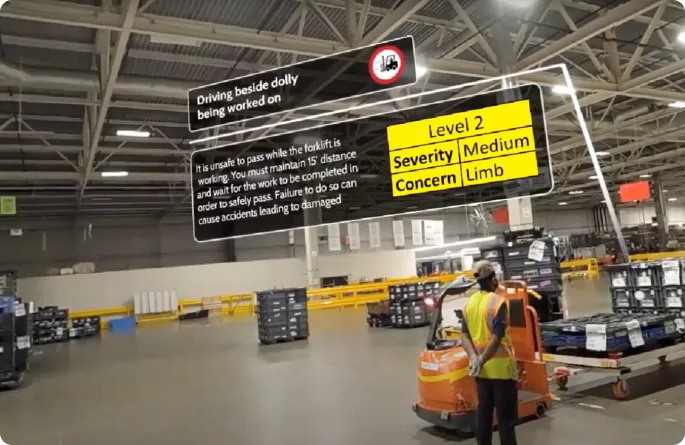
Filmed scenes become training once learners have to act. Hotspots, branching decisions and knowledge checks are layered on top of the footage, so trainees choose what to do and see what happens next.
- Branching scenarios
- Hotspots and knowledge checks
- 3D compositing and special effects
Update Footage Without Rebuilding the App
VR Vision's 360 video loader keeps video files separate from the training application. Footage can be uploaded and updated on headsets on its own, so refreshing a scene doesn't mean republishing the course.
Swap or update a video file and the next session plays the new footage. The app stays the same.
Production toolset, plus in-house tools
 Mistika VRStitching & stereo refinement
 AdobeEditing & effects
 Blender3D & effects compositing
 UnityApplication development
360° Video or Digital Twin?
Both deliver immersive training. Choose 360 when trainees need to see and decide. Choose a digital twin when they need to touch and operate.
| Criteria | Interactive 360° video | Digital twin (3D / CGI) |
|---|---|---|
| How it's made | Filmed on location with 360° cameras, then made interactive | Modeled in 3D from CAD, scans and site photos |
| What trainees do | Look around, make decisions and respond to prompts inside real footage | Pick up, operate and manipulate equipment with their hands |
| Best for | Site orientation, hazard recognition, situational awareness, soft skills | Hands-on procedures, equipment operation, fault-finding, motor skills |
| Production time | Days to weeks for a simple video. Longer with heavy graphics or sound design | Working pilot in 3–4 months for a custom build |
| Typical cost per module | $30K–$60K | $65K–$120K |
Typical per-module ranges for custom builds. Final pricing depends on scope.
Explore Digital TwinsHave a Site Your Crews Need to See First?
Book a 30-minute demo. Tell us where your people work and what they need to recognize, and see how 360 video would capture it.
360 Video Production, Answered
What is 360 video production for VR training?
360 video production is the process of filming a real location with a multi-lens camera that records every direction at once, then stitching, editing and sound-designing the footage so it can be viewed in a VR headset. For training, it lets workers experience the real site, people and conditions before they're there in person.
How much does 360 video production cost for VR training?
Interactive 360 video typically runs $30,000 to $60,000 per module, depending on the number of scenes and locations and how much interactivity and post-production is involved. That's about half the cost of a custom 3D (CGI) module, which runs $65,000 to $120,000.
How long does it take to produce a 360 training video?
A simple 360 training video can be produced in a few days to a few weeks. Projects with extensive graphics, effects or sound design take longer, from several weeks to a few months.
What cameras and audio equipment does VR Vision use?
Scenes are filmed on professional multi-lens 360° rigs at up to 11K resolution, including stereoscopic rigs such as the Insta360 Pro 2, with a GoPro used for synchronized point-of-view close-ups. Audio combines individual microphones with ambisonic and binaural spatial audio. Footage is stitched and refined in Mistika VR and finished in Adobe tools.
Should we choose monoscopic or stereoscopic 360 video?
Choose stereoscopic when depth and presence matter, such as close-up work or high-hazard environments. It records a separate image for each eye but costs more to produce. Monoscopic records a single panoramic image and costs less, which suits walkthroughs and orientation.
Can 360 videos be updated after launch?
Yes. VR Vision's 360 video loader keeps footage separate from the training application, so videos can be uploaded and updated on headsets without rebuilding or republishing the app.
Where 360 video training works best
360 video production supports these training programs.
More of What Powers VR Vision Training
Interactive 360 Video
Navigable, decision-based training built on your real footage.
Learn moreDigital Twins
Exact virtual replicas of your equipment and sites for hands-on practice.
Learn moreInteraction Design
Natural, intuitive interactions inside every virtual environment.
Learn moreVision SDK
The in-house engine behind every VR Vision module.
Learn more