
The bottom line
Meta VR Glasses weigh about 100 grams on the head, run the full Meta Quest app library, and will sell for US$1,299 when they ship in spring 2027. That combination addresses the two issues that have slowed enterprise headset rollouts for years: comfort over long sessions and cost per seat. Organizations should keep building on Meta Quest today, because that content carries forward, and plan VR Glasses pilots once devices and fleet management tools are available.
What Meta announced
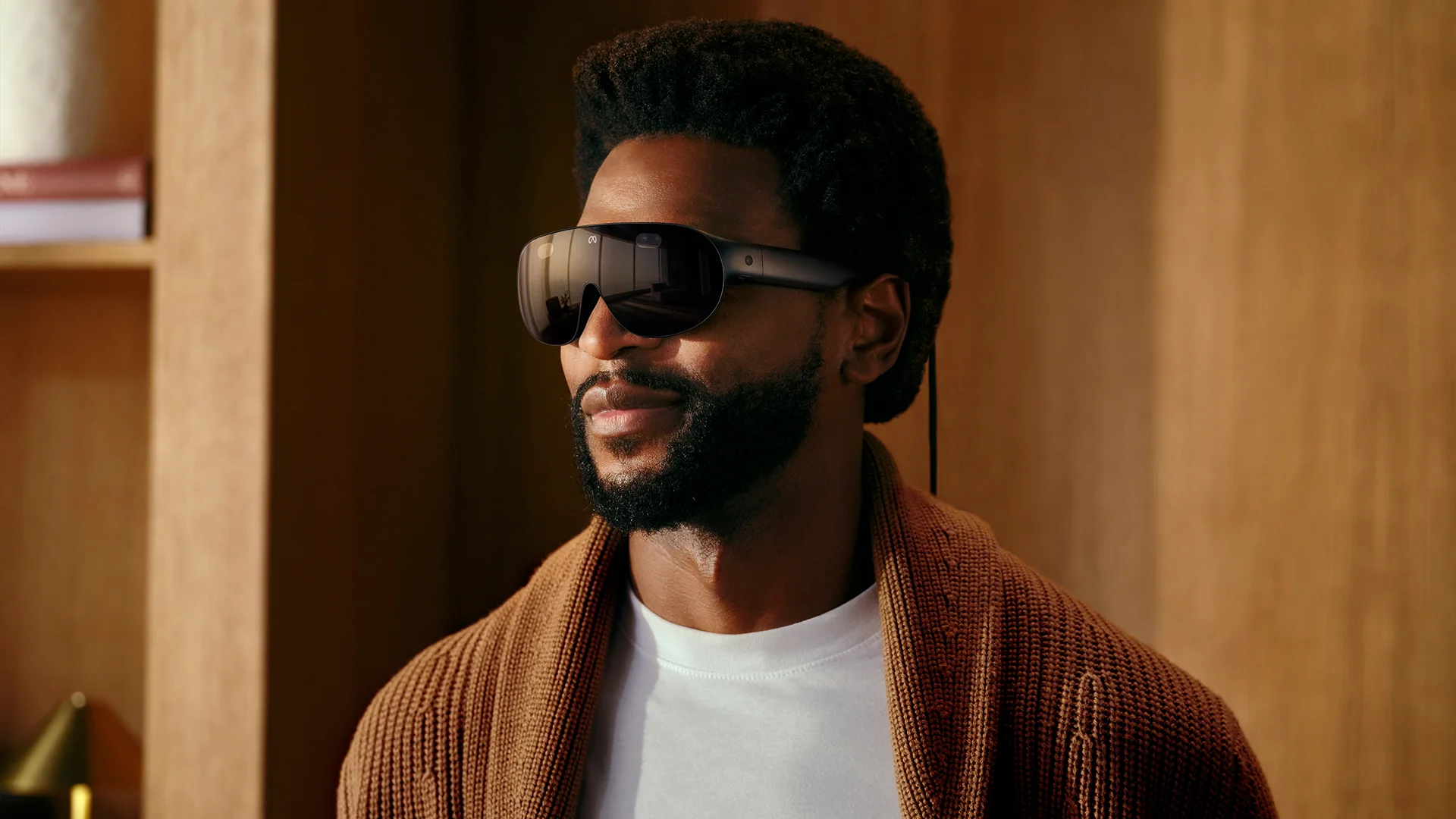
Meta unveiled VR Glasses at its Connect conference on September 23, 2026. Known during development as Project Phoenix, the device moves the processor and battery out of the headset and into a compute puck connected by an optical cable. The visor weighs about 100 grams. The puck adds roughly 300 grams and fits in a pocket.
The display is the sharpest Meta has shipped: micro-OLED panels at 2,412 x 2,288 pixels per eye, 37 pixels per degree, and a refresh rate up to 120Hz. For comparison, Meta Quest 3 delivers 25 pixels per degree.
Input works much like Apple Vision Pro: look at a button and pinch to select. Quest Touch Plus controllers are supported but optional. The lenses adjust from 56 to 70 mm and accept prescription inserts from Zenni. Meta rates the battery at more than three hours of mixed use, and the puck can charge while in use.
Key detail for enterprise buyers
VR Glasses run the same operating system and app store as Meta Quest. Training content built for Quest today will run on the new device, although modules designed around controllers or peripheral vision may need adjustments.
Why this changes the enterprise math
Comfort sets session length
Front-heavy headsets are the most common comfort complaint in training rooms. Meta Quest 3S weighs 514 grams, and Vision Pro weighs 750 to 800 grams before its battery. At 100 grams, longer and repeated sessions become realistic, along with extended use in places like operating rooms and design studios.
Cost per seat drops
At US$1,299, VR Glasses cost about a third of Vision Pro's current US$3,699 price. For a 50-seat program, that is roughly $65,000 in hardware instead of $185,000.
Content carries over
Because the device runs the Quest library, organizations investing in Quest-based training today are not betting on a platform that will be stranded.
Enterprise applications across industries
Most of VR Vision's deployments are in energy, utilities and manufacturing, but the case for a lighter, sharper headset reaches much further. These are the sectors where the new form factor matters most.
01Healthcare and clinical education
Surgeons already wear headsets in the operating room. A UC San Diego study of 32 tear duct surgeries found procedures ran 19% faster with Apple Vision Pro as the display, with identical outcomes. A 100-gram device makes that use more practical across long procedures and lowers the cost of equipping nursing and clinical skills labs for IV insertion, patient communication and emergency response drills.
02Aviation and aircraft maintenance
Airlines are moving familiarization training out of expensive full-flight simulators. Kalitta Air is deploying VR across its Boeing 777 fleet for pilots and maintenance crews, and KLM built an engine maintenance app on Vision Pro. Lighter glasses suit long procedural walkthroughs, and built-in DisplayPort input lets a technician mirror a laptop running maintenance documentation.
03Energy and utilities
High-hazard work such as switching, substation procedures and live-line safety is where VR training has its deepest track record. In VR Vision's Avangrid deployment, VR training built competency 65% faster than traditional methods.
One caution: the 70-degree horizontal field of view is narrower than Quest 3's 110 degrees, so hazard-awareness scenarios that rely on peripheral vision may still be better delivered on Quest.
04Manufacturing and automotive
Assembly training, quality inspection and design review all benefit from sharper displays. At 37 pixels per degree, small labels, torque specifications and fine component detail become readable in a way they were not on earlier Meta headsets. That matters for upskilling at scale, including electric vehicle reskilling programs.
05Architecture, engineering and construction
Design teams can walk clients through a building before it is built without handing them a bulky headset. Wireless multi-screen streaming from a Mac or PC brings BIM and CAD reviews into the headset, and the lighter fit lowers the barrier for executives and owners who have avoided VR.
06Retail, hospitality and customer service
Soft skills training has some of the strongest evidence behind it. In PwC's study of VR leadership training, VR learners finished four times faster than classroom learners and were 275% more confident applying what they learned. Store layout planning and merchandising reviews are a natural second use.
07Logistics and warehousing
New hires can practice equipment operation, picking workflows and safety procedures before they step onto the floor. High-turnover operations gain the most, since faster onboarding compounds across hundreds of hires a year.
08Pharmaceuticals and life sciences
Cleanroom gowning, aseptic technique and lab procedures are expensive to practice in the real environment. Sharper text also helps with SOP-heavy training where trainees must read labels and batch records.
09Education and workforce development
Colleges and trade schools need devices that fit a wide range of students. Prescription inserts, two frame sizes and a lower price make VR Glasses easier to justify for electrical, mechanical and health sciences programs.
10Sales and trade shows
Anyone who has run a VR demo at a trade show knows the friction of fitting a heavy headset on a stranger. A glasses-style device makes demos of heavy equipment, facilities and complex systems faster to run and easier for prospects to agree to.
Meta VR Glasses vs. Apple Vision Pro
Vision Pro still wins on raw resolution and field of view. Meta wins on weight, price, pixel density and content library.
For most training programs, Meta's trade-offs are the right ones.

Full specifications
Meta figures are pre-release. Vision Pro pixels per degree reflects Meta's stated comparison. Prices in US dollars.
| Specification | Meta VR Glasses | Apple Vision Pro (M5) |
|---|---|---|
| Price (US) | $1,299 | $3,699 (raised from $3,499 in June 2026) |
| Availability | Spring 2027 | Now |
| Weight on head | ~100 g | 750–800 g |
| Off-head weight | ~300 g compute puck | 353 g battery |
| Display | Micro-OLED, 2,412 x 2,288 per eye | Micro-OLED, ~3,660 x 3,200 per eye |
| Pixels per degree | 37 | ~34 |
| Field of view | 70° H x 66° V | ~100° H |
| Refresh rate | Up to 120Hz | Up to 120Hz |
| Processor and memory | Snapdragon Reality Elite, 12 GB RAM | Apple M5 and R1, 16 GB |
| Storage | 128 GB, microSD up to 1 TB | 256 GB to 1 TB |
| Battery | 3+ hours mixed use | Up to 2.5 hours general use |
| Input | Eyes, hands, voice; Touch Plus controllers optional | Eyes, hands, voice; game controllers supported |
| Prescription lenses | Zenni inserts | ZEISS inserts |
| App library | Full Meta Quest library | visionOS and iPad apps |
| Fleet management | Not yet announced | Apple Business Manager with MDM |

Vision Pro still makes sense for organizations standardized on Apple devices, for teams that need the widest view and highest resolution, and for anyone who needs hardware now rather than in 2027. Surgical visualization and high-end design review are its strongest enterprise niches today.
What to watch before you commit
- Fleet management is the open question. In February 2026, Meta stopped selling commercial Quest headsets and new Horizon managed services subscriptions. Existing customers keep the service at no cost until it shuts down on January 4, 2030. Meta has not said how VR Glasses will be managed at scale. Third-party platforms such as ArborXR, which VR Vision uses for device management, are the likely path, but confirm support before buying.
- The tether adds a step. Every user has to clip on a puck and route a cable, which also creates a snag point in physical training spaces.
- Battery covers a session, not a shift. Three hours is enough for a training block. All-day use will need charging stations or wired power.
- Two sizes means two SKUs. Standard and Large frames are sold separately, which complicates shared device pools.
- Specs and price can still move. These figures come from launch-day announcements, and memory shortages have already pushed hardware prices up across the industry this year.
What to do now
- Keep building on Quest. Content built for Meta Quest 3 and 3S today runs on VR Glasses tomorrow.
- Design for hand tracking. VR Glasses ship without controllers. New modules should work with gaze and pinch input, with controllers as an option.
- Settle device management early. Choose a management platform that supports Meta hardware and plan for the end of Horizon managed services.
- Budget a 2027 pilot. Run a small cohort on VR Glasses alongside Quest and measure whether the comfort gain turns into longer, more frequent sessions.
Plan training that works on today's headsets and the next generation
VR Vision Group has delivered more than 100 enterprise VR training deployments for organizations including Toyota, Siemens, Coca-Cola and Toronto Hydro. As an authorized Meta partner, VR Vision helps L&D and IT teams build training that runs on Meta Quest now and carries forward to new hardware as it ships.
Book a demoSources
- Road to VR: Meta announces VR Glasses, specs and pricing
- Road to VR: Meta VR Glasses hands-on
- UploadVR: Meta VR Glasses officially announced
- Apple: Vision Pro technical specifications
- Road to VR: Apple raises Vision Pro price
- VR.org: UC San Diego Vision Pro surgery study
- Kalitta Air: VR training partnership with Visionary Training Resources
- Virtual Verse Studio: Vision Pro enterprise use cases (KLM)
- PwC: VR soft skills training study
- UploadVR: Meta shuts down Quest for Business program