


Substation training has a problem most utilities know well. The procedures that matter most, like switching, isolating and grounding equipment and handling SF6 gas, are the ones you can’t safely stage on live equipment. New technicians learn them from diagrams, classroom sessions and shadowing, then perform them for real with high voltage a few feet away.
Virtual reality closes that gap. VR Vision builds substation training that recreates real stations and switchgear as digital twins, so crews can practice every step, make mistakes and repeat until the procedure is second nature. This guide covers what substation training needs to include, why utilities are moving it into VR, and the results early adopters like Toronto Hydro and Avangrid have seen.
What substation training covers
Substation technicians, electricians and operators work around energized transformers, breakers, switchgear and bus. A complete substation training program typically covers:
- Hazard awareness and site entry: minimum approach distances, recognizing energized parts, and notifying the control center before entering and leaving the station.
- Switching procedures: reading switching orders, operating disconnects and breakers in the right sequence, and verifying each step with a second person.
- Isolation, lockout/tagout and grounding: isolating equipment, testing for absence of voltage and applying protective grounds before work begins.
- SF6 gas handling: monitoring, recovering and refilling SF6 in gas-insulated switchgear without releases.
- Arc flash and PPE: choosing and wearing arc-rated clothing and equipment for the task.
- Equipment maintenance: inspection, testing and component replacement on transformers, breakers and relays.
- Emergency response: what to do after a flashover, a fire or an injured coworker, including confined space rescue.
Standards that shape substation training
| Standard | Where | What it covers |
|---|---|---|
| OSHA 29 CFR 1910.269 | United States | Operation and maintenance of power generation, transmission and distribution equipment, including qualified-worker training, minimum approach distances, lockout/tagout, grounding and substations. |
| NFPA 70E | United States | Workplace electrical safety for arc flash and shock hazards. Utility transmission and distribution work falls mainly under 1910.269, but many utilities apply 70E practices in their programs. |
| CSA Z462 | Canada | Canada’s workplace electrical safety standard, harmonized with NFPA 70E and the Canadian Electrical Code. The current edition is Z462:24. |
| NERC PER-005-2 | North America | A systematic approach to training for personnel who perform or support real-time operations on the bulk electric system, including transmission operators and owners. |
Your utility’s own safety rules and switching procedures sit on top of these standards. VR modules should mirror them step for step.
Why utilities are moving substation training into VR
Live equipment is the wrong place to learn
According to the Electrical Safety Foundation, 2,070 U.S. workers died from electrical exposure between 2011 and 2024. Power-line installers had the highest electrical fatality rate of any occupation, at 6.01 deaths per 100,000 workers, and contact with nearby energized equipment caused 12% of electrical deaths. Substation work carries the same exposure, which is why so much of it can only be practiced on de-energized equipment, in a training yard, or not at all.
An experienced workforce is retiring
The people who know these procedures best are leaving. The IEA reports that in advanced economies there are 1.4 grid workers nearing retirement for every worker under 25. In the U.S., CEWD found 56% of energy workers have fewer than 10 years of experience. In Canada, Electricity Human Resources Canada forecasts the electricity sector needs close to 28,000 new workers by 2028. Meanwhile, the BLS projects 10% growth for powerhouse, substation and relay repairers from 2025 to 2035. Utilities need a faster way to turn new hires into qualified technicians.
Rare, high-risk tasks fade without practice
Some switching operations and emergency responses happen only a few times a year, so skills fade between real events. Toronto Hydro describes switching as “likely the highest-risk activity we ask our crews to perform.” In VR, a crew can rehearse the exact procedure the day before the job.
Outages and travel make hands-on training expensive
Taking a bay or a station out of service for training is rarely possible, and sending crews to a central training yard costs time and money. When E.ON’s Bayernwerk started building VR models of its substations, it expected to save 800 to 1,000 hours of travel a year once its stations were digitized.
What VR substation training looks like
VR Vision’s substation modules are built as digital twins of real equipment and real stations, so the layout, labels and sequence match what crews will see in the field.
Substation walkthrough
A full virtual substation trainees explore at their own pace to learn layout, equipment and hazards before their first site visit.
Isolate and ground on SF6 switchgear
Step-by-step isolation and grounding on SF6 switchgear, practiced without live equipment, in guided and evaluation modes.
SF6 gas handling and switching
SF6 gas replacement and switching procedures at a substation, inside a multiplayer training world shared across states.
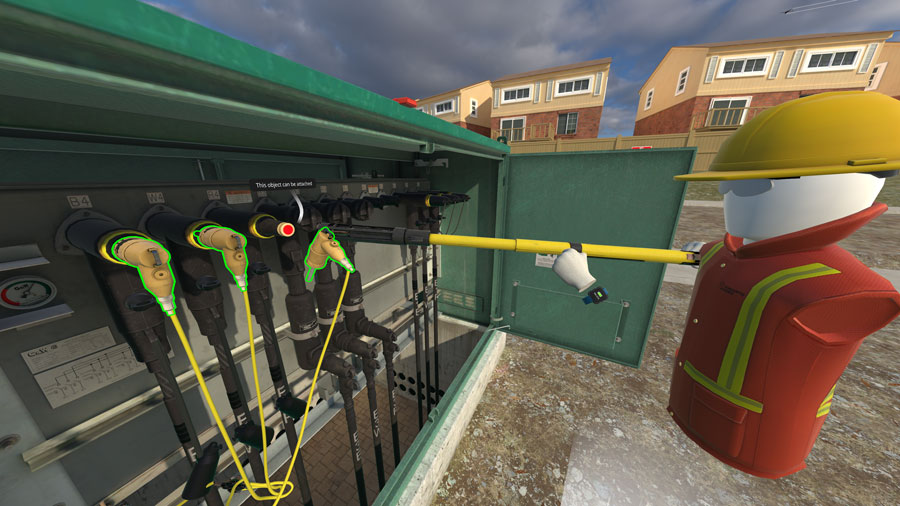
- Multiplayer crew scenarios. One technician operates while another verifies, exactly like a real switching order, even when crew members are in different locations.
- Guided and evaluation modes. New hires learn step by step, then prove competency in an evaluation mode that tracks every action.
- Trainer oversight. In Vision Portal, trainers watch live headset feeds, guide sessions and track results across teams.
- Standalone headsets. Modules run on standalone Meta Quest headsets, so training happens at any depot or service center without a PC.
Results from utilities using VR substation training
30% less time-to-train
Hundreds of technicians trained on switchgear, vaults and powerline work over three years, with 40 Quest headsets and new content added regularly. Read the case study
65% faster to competency
Hundreds of Quest headsets across a 24-state footprint, covering substations, SF6 switchgear, switching and confined space rescue, with results pushed to the LMS. Read the case study
The wider industry is moving the same way. EPRI offers its members a VR digital twin of a live substation for site tours, contractor orientation and pre-job briefings.
VR vs. traditional substation training
| Classroom | Training yard or field | VR training | |
|---|---|---|---|
| Practicing switching and isolation | Diagrams and procedures | Supervised, on de-energized or live equipment | Full sequence, repeatable on demand |
| Rare emergencies | Discussed, not practiced | Rarely staged | Run any scenario, any time |
| Safety risk while learning | None, but no hands-on practice | Real electrical exposure | Zero exposure to energized equipment |
| Outages and travel | None | Needs outages or travel to a yard | Trains at any depot |
| Consistency | Depends on the instructor | Depends on the site and crew | Identical scenario for every crew |
| Proof of competency | Written test | Supervisor sign-off | Tracked results in Vision Portal |
How to start a VR substation training pilot
- Pick one procedure. Choose something high-risk and widely performed, like isolate and ground on your most common switchgear.
- Gather your source material. Switching procedures, single-line diagrams, equipment drawings and photos or scans of the station.
- Build and validate. Your subject-matter experts and safety team review every step against your own rules.
- Pilot with one crew. Compare time-to-competency and errors against your current training.
- Scale. Roll out through Vision Portal and your LMS, then add the next procedure.
For the numbers side, see how to measure VR training ROI for utility workforces, or explore VR training for energy and utilities.
Substation training FAQ
What is substation training?
Substation training teaches technicians, electricians and operators to work safely in and around electrical substations. It covers hazard awareness, switching, isolation and grounding, lockout/tagout, SF6 gas handling, arc flash PPE, equipment maintenance and emergency response.
Can VR replace hands-on substation training?
No. VR prepares crews before they touch live equipment and lets them rehearse rare tasks, but utilities still require supervised field practice and qualification under their own safety rules. VR makes that field time safer and more productive.
Which substation procedures work best in VR?
Procedures that are high-risk, hard to stage or rarely performed: switching sequences, isolate and ground, SF6 gas handling, confined space rescue and emergency response. Site walkthroughs are also valuable for new hires and contractors before their first visit.
Does VR substation training work for crews?
Yes. Multiplayer VR puts several trainees in the same virtual station, so crews can practice switching orders where one person operates and another verifies, even from different locations.
Which standards apply to substation training?
In the U.S., OSHA 29 CFR 1910.269 governs power generation, transmission and distribution work, and NERC PER-005-2 covers training for real-time operations staff. In Canada, CSA Z462 sets workplace electrical safety requirements. Your utility’s own safety rules and switching procedures sit on top of these.
See substation training in VR
Walk through the Toronto Hydro and Avangrid modules with the VR Vision team and get a fixed-price pilot proposal for your crews.
Book a demo →Read the Toronto Hydro case studySources
- OSHA 29 CFR 1910.269, OSHA
- CSA Z462:24, CSA Group, 2024
- NERC PER-005-2, NERC
- Workplace injury and fatality statistics, ESFI, Jan 2026
- World Energy Employment 2025, IEA, Dec 2025
- CEWD Gaps report coverage, APPA, Feb 2024
- Electricity in Demand 2023 to 2028, EHRC, Oct 2023
- Electrical and electronics installers and repairers, BLS, Aug 2026
- How VR enhances our training, Toronto Hydro, Aug 2026
- VR Substation, EPRI
- E.ON trains substation workers with VR, Renewable Energy World, Jun 2019