
The bottom line
More realism does not always mean better VR training. VR training fidelity comes in four types (visual, interaction, behavioural and environmental), and every step up in each one adds cost. Spend it where the skill depends on detail: fine motor work, visual inspection, stress response and spatial judgement. For procedures and sequences, a simpler build teaches just as well for a fraction of the price.
"How real does it need to look?"
It's one of the first questions on almost every project I work on, and the answer people expect is "as real as possible." I build 3D assets for a living, so you'd think I'd agree. Most of the time I don't.
Photorealism is the most expensive thing you can buy in VR training. For a lot of skills, it doesn't teach anything a simpler build wouldn't. Getting this call right is often the difference between a module at the low end of a budget and one at the top of it.
This guide covers the four types of fidelity, where each one earns its cost, where it doesn't, and how our team decides what level a training program actually needs.
What fidelity means in VR training
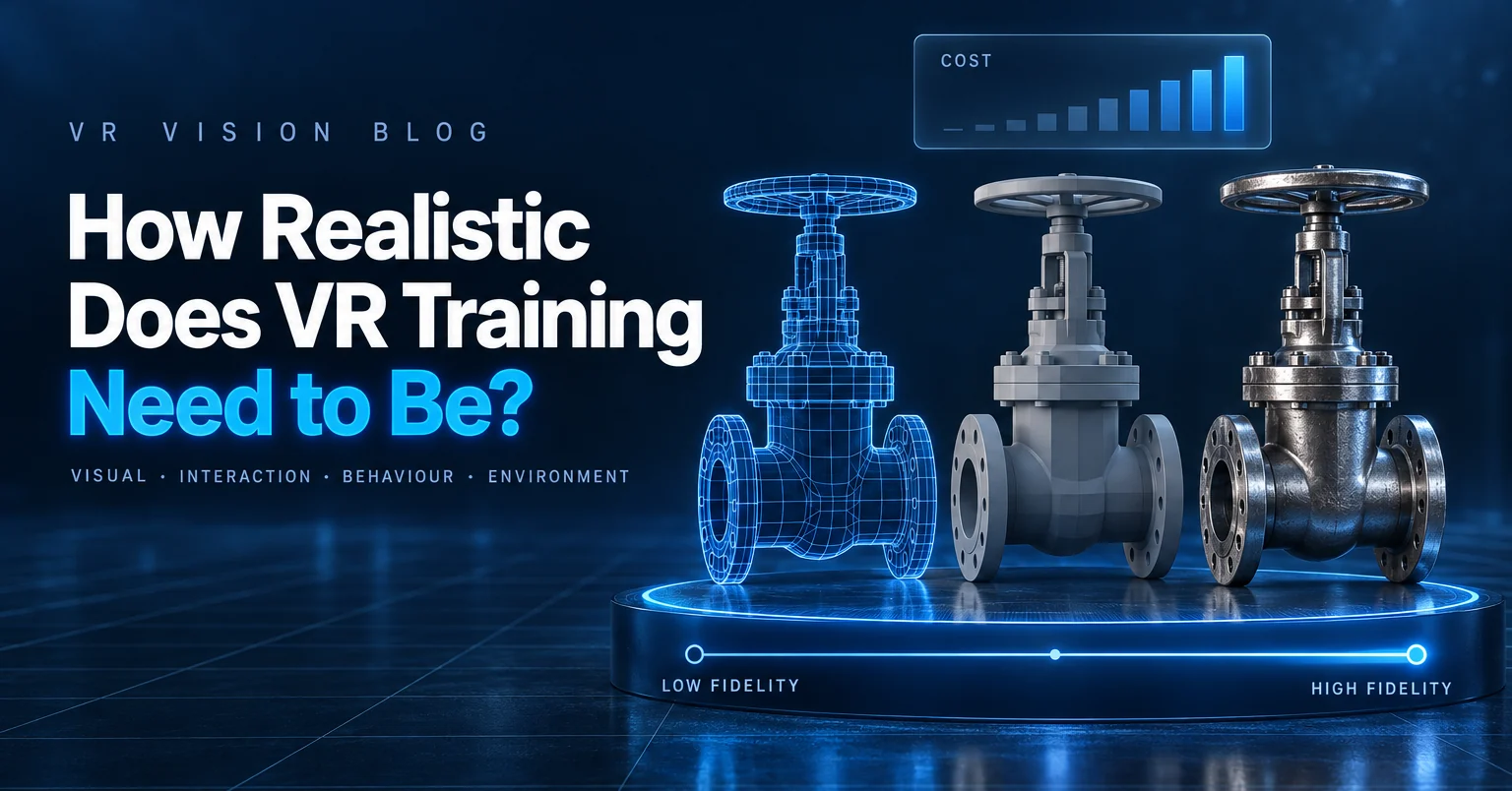
Fidelity is how closely a training simulation matches the real job. The common mistake is treating it as one dial. It's actually four, and you can turn each one up or down on its own.
The four types of VR training fidelity, with a lower and higher example of each.
| Type | What it covers | Lower fidelity | Higher fidelity |
|---|---|---|---|
| Visual | How real the environment, equipment, lighting and textures look | Stylized, low-poly models with simple lighting | Photoreal models with accurate materials and reflections |
| Interaction | How closely hands, tools and physics behave like the real thing | Point and click with a controller button | Hand-tracked grips, turns and tool use with realistic physics |
| Behavioural | How equipment and people in the scene respond to the trainee | Fixed, pre-scripted steps with one right path | Systems that react to errors, with branching consequences |
| Environmental | Everything around the task: sound, weather, people, activity | A quiet, empty room | Alarms, crew radio chatter, noise and moving equipment |
Simulation researchers reached the same conclusion years ago. A widely cited 2014 paper in Academic Medicine argued that the word "fidelity" causes more confusion than it solves. What drives learning, the authors found, is functional task alignment: whether the simulation asks the trainee to do what the real task asks, not whether it looks identical.
The question to ask
Not "how real can we make it?" but "what does the trainee need to see, do and feel to learn this skill?" Anything beyond that is cost without a learning return.
Where high fidelity pays off
High fidelity earns its cost when the skill itself depends on precise detail. Four situations come up again and again in our energy, utility and manufacturing projects.
Fine motor skills and muscle memory
When exact hand placement or tool handling is part of doing the job safely, a controller button won't transfer. Hand tracking and realistic interaction let trainees build the motion, not just the knowledge.
Visual inspection
Spotting hairline cracks, corrosion, a loose connection or a wrong gauge reading needs high-resolution textures and accurate lighting. If the defect isn't visible in the headset, the trainee can't learn to find it.
High-stress hazard response
Alarms, noise, smoke and time pressure recreate the stress of a real emergency. Environmental fidelity is what turns a calm walkthrough into practice for the moment it matters.
Spatial judgement
When trainees have to judge clearances, reach, approach distances to energized equipment or movement in tight spaces, accurate scale and depth are the lesson. Get the scale wrong and you train the wrong habit.
Where it usually doesn't
For a lot of training, extra realism adds cost without improving what people remember.
- Procedures and sequencesLockout/tagout steps, start-up checklists and switching orders depend on the logic of the sequence. "Isolate, verify, then open valve B" is learned the same way whether the valve is photoreal or not.
- Soft skills and decision-makingCommunication, leadership and decision-tree training work well with stylized avatars and focused dialogue choices. The conversation is the content.
- Basic equipment identificationLearning what a tool is called, what it does and where it lives doesn't need sub-millimetre detail.
- Site orientationA first look at a plant or substation layout can be taught with a simple 3D block-out or an interactive 360 tour of the real site.
If you're weighing a fully custom build against existing content for this kind of training, our guide to custom vs. off-the-shelf VR training covers the trade-offs.
How fidelity drives VR training cost
Every step up in realism multiplies development hours. Here's where the money goes:
- 3D assets. Photoreal equipment needs detailed modelling, texturing, often photogrammetry or CAD conversion, and then heavy optimization so it still runs on a standalone headset. A stylized model can take a fraction of the effort of a photoreal one built to survive close inspection.
- Interaction programming. Simulating real physical behaviour (a cable bending, a bolt reaching torque, fluid moving through a line) needs custom physics code and a lot of tuning. Good VR interaction design is where much of this effort goes.
- System logic and edge cases. Realistic behaviour means handling every wrong move a trainee could make, not just the right path. Each branch is logic to design, build and test.
- QA and testing. More physics and more branches mean more bugs, more performance issues and more test cycles before release.
Realism doesn't add cost in a straight line. Each layer multiplies the work in the layers around it.
For full budget ranges beyond fidelity, see What Does VR Training Actually Cost?
The fidelity ladder: from 360 video to custom 3D
In practice, fidelity decisions show up as format decisions. These are the ranges VR Vision works within.
Typical cost by format. Final pricing depends on scope, number of scenarios and interaction depth.
| Format | Typical cost | Realism | Best for |
|---|---|---|---|
| Licensed pre-built modules | Lowest: licence an existing module instead of building one | Set by the existing module | Common energy and utility procedures, fast rollout |
| Interactive 360 video | $30K to $60K per module | Photoreal: filmed on your real site in 11K | Orientation, hazard spotting, decisions with branching choices |
| Custom 3D simulation | $60K to $120K per module | Stylized to photoreal, set by scope | Hands-on procedures, tool use, failure scenarios you can't film safely |
Interactive 360 video is the shortcut to visual fidelity. You get a photoreal environment because it's real footage, for about half the cost of a 3D build. The trade-off is interaction: trainees can look, choose and respond, but they can't pick up a tool and use it. When hands-on practice is the point, that's where custom 3D simulation comes in.
Timelines follow the same pattern. Licensed modules can be running in a field pilot 1 to 2 months after contract. A custom 3D build typically reaches a working pilot in 3 to 4 months and a production release at around 5.5 months.
The headset sets the ceiling
The hardware you deploy on caps how much fidelity is even possible.
- Standalone headsets (Meta Quest 3S, PICO 4 Enterprise). These run on mobile chips, so every scene works inside a tight budget for polygons, lighting and texture size. Most enterprise programs use them anyway, because they're wireless, affordable and easy to manage at scale.
- PC-tethered VR. A high-end PC can drive real-time lighting, dense particle effects and photoreal textures. The price is a gaming-class PC at every station, a cable, and a much harder deployment.
- Frame rate. This one isn't optional. Meta requires Quest apps to hold at least 60 frames per second, and dropped frames are a common trigger for motion sickness. A beautiful scene that stutters is worse training than a plain one that runs smoothly.
That's why we build to the target headset from day one, and why photoreal detail on a Quest 3S is a targeted choice, not a default. Our comparison of VR headsets for business covers the current options.
How we decide on fidelity, in practice
Every project goes through the same four steps before any high-end art gets made.
- ObjectiveName the exact skill being transferred.We write the learning objective as an action: "identify a failed insulator" or "complete isolation in the correct order." If visual precision isn't part of that action, visual fidelity stays low.
- BaselineStart at minimum viable realism.We begin with the lowest visual and interaction complexity that still meets the objective, then add detail only where testing shows it's needed.
- FocusConcentrate detail where it matters.Most of the environment stays simple. High-detail assets are saved for the critical equipment, the defect the trainee has to spot, or the failure state that hurts people.
- ValidateTest with real trainees early.A low-fidelity prototype in front of actual workers tells us whether learning transfers before anyone commits budget to high-end art.
It's also the right order if you're scoping a project internally: audit your learning objectives, set a budget tier based on headset and deployment scale, then prototype the critical interactions early. Our Industrial VR Training Buyer's Guide walks through the full evaluation.
A worked example: industrial valve maintenance
Here's how the same training topic plays out at two fidelity levels.
Lower fidelity
Procedure-first build
- Controller point-and-click on clearly highlighted, stylized valves
- Step-by-step checklist with instant feedback on the sequence
- Simple, pre-scripted equipment responses
Lower cost, faster build. Ideal for learning the operating sequence and the safety steps.
Higher fidelity
Hands-on build
- Hand tracking to grip, turn and align components, with visual and audio feedback on torque and thread alignment
- Photoreal materials and dynamic lighting to inspect seals and threads for wear and micro-cracks
- Equipment that reacts to mistakes, such as a mis-seated gasket that leaks under pressure
Higher cost, longer build. Worth it when tactile assembly and defect inspection are the skills that prevent failures.
What most programs actually do
Mix the two. Build the sequence in lower fidelity, then invest in high fidelity only for the two or three steps where a mistake causes a leak, an injury or downtime.
When higher fidelity is worth paying for
Higher fidelity is justified when getting it wrong in the real world is expensive or dangerous.
Pay for realism when
- The event is high-risk and rare. Emergency shutdowns, arc flash response or equipment failures you can't safely or practically stage for real.
- Real equipment time is expensive. Taking a production line, turbine or substation offline for training can cost thousands of dollars an hour.
- The program will run at scale. A higher build cost spread across thousands of trainees over several years can work out cheaper per person than repeated in-person sessions.
To test the numbers for your own program, try our VR training ROI calculator.
Work with VR Vision
Scope the right fidelity before you build
Tell us the skill you need to train. We'll show you where realism will pay off, where it won't, and what that means for budget and timeline.
- A fidelity recommendation for each learning objective
- 360 video, custom 3D or a mix, matched to your headsets
- A fixed-price pilot proposal
Trusted by
ToyotaSiemensCoca-ColaToronto Hydro
Frequently asked questions
What is fidelity in VR training?
Fidelity is how closely a VR simulation matches the real task. It has four parts: visual fidelity (how real it looks), interaction fidelity (how real hands, tools and physics behave), behavioural fidelity (how equipment and people react to the trainee) and environmental fidelity (sound, weather and background activity). Each one can be set high or low on its own.
Is high-fidelity VR training always better?
No. High fidelity improves learning when the skill depends on detail, such as fine motor work, visual inspection, stress response and spatial judgement. For procedures, sequences, soft skills and orientation, a simpler build usually teaches just as well at a lower cost.
How much does fidelity add to VR training cost?
It's the biggest single cost driver. At VR Vision, interactive 360 video modules typically cost $30,000 to $60,000, while custom 3D simulations typically run $60,000 to $120,000 per module. Where a 3D build lands in that range depends mostly on visual realism, physics-based interaction and branching logic.
What is the difference between low-fidelity and high-fidelity simulation?
A low-fidelity simulation focuses on the logic of a task, using simple visuals and controller input. A high-fidelity simulation recreates the look, feel and behaviour of real equipment, often with hand tracking, realistic physics and responses to errors. Many effective programs combine both.
Can standalone headsets like the Meta Quest 3S run high-fidelity training?
Yes, within limits. Standalone headsets run on mobile processors, so detail has to be carefully optimized to hold a smooth frame rate. Targeted high fidelity on key equipment works well. Photorealism everywhere usually needs PC-tethered VR.
Sources
- Hamstra, S.J., Brydges, R., Hatala, R., Zendejas, B. and Cook, D.A. (2014). Reconsidering fidelity in simulation-based training. Academic Medicine, 89(3), 387-392.
- Meta Horizon developer documentation. VRC.Quest.Performance.1: minimum frame rate requirement.