

Quick Answer
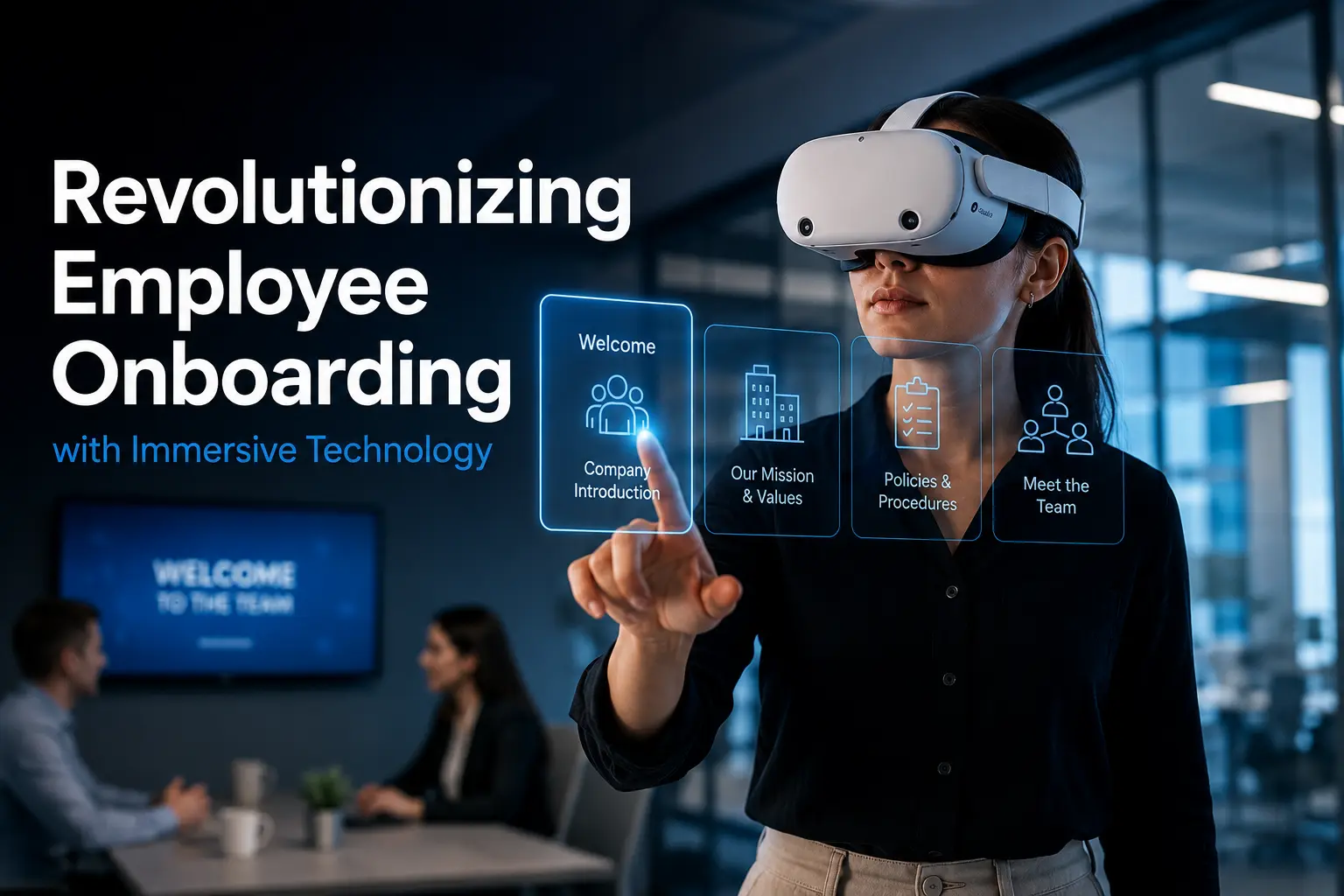
VR onboarding is enterprise-grade employee orientation delivered through immersive virtual reality simulations. In 2026, companies using VR onboarding report up to 75% knowledge retention (vs. 10% in classroom training), 4x faster skill acquisition, and a 275% lift in employee confidence — making it the most measurable upgrade to traditional onboarding programs available today.
Traditional onboarding is broken. New hires sit through slide decks, shadow a senior employee for a few shifts, and are pushed onto the floor before they're ready. In high-stakes industries — energy, utilities, manufacturing, rail — this translates directly into errors, safety incidents, and slow time-to-productivity.
Immersive virtual reality fixes the three things classroom training can't: hands-on practice, consistency at scale, and measurable proof of competency. This article breaks down what 2026 enterprise VR onboarding actually looks like, the data behind the ROI, and three real deployments showing the numbers.
The 2026 Data on VR Onboarding
The case for immersive onboarding stopped being theoretical years ago. Here are the numbers that matter to L&D and operations leaders right now:
Why Immersive Onboarding Outperforms Classroom Training
Three things change when you put a new hire in a headset. First, they're not watching — they're doing. Second, every learner gets identical training regardless of location or trainer availability. Third, every action is captured as performance data your LMS can act on.
5 Benefits of VR Employee Onboarding in 2026
01 — ENGAGEMENT
Active learning, not passive watching
Headsets eliminate distraction. Learners report 3.75x stronger emotional connection to content vs. classroom training, which translates directly into retention.
02 — SPEED
4x faster time-to-competency
Repeatable practice in a risk-free digital twin means new hires hit proficiency in days instead of weeks. Manufacturers using VR onboarding report 12-week programs compressed to 3–4 weeks.
03 — CONSISTENCY
Identical training, every site
Whether a technician onboards in Texas or Toronto, they complete the same scenarios with the same evaluation criteria. No variance from trainer to trainer.
04 — COST
Lower total cost at scale
Meta Quest 3 standalone headsets start at roughly $500 — no PC, no cables. Travel, instructor time, and physical equipment costs collapse once content is built once and deployed everywhere.
05 — DATA
Every action becomes measurable
Vision Portal captures every interaction, completion, score, and attempt. L&D leaders see proficiency trends across the workforce, not just attendance.
VR Onboarding vs. Traditional Onboarding: Side by Side
| Dimension | Traditional | VR Onboarding |
|---|---|---|
| Knowledge retention | ~10% | Up to 75% |
| Time-to-competency | 8–12 weeks | 2–4 weeks |
| Consistency across sites | Trainer-dependent | Standardized |
| Performance data | Attendance only | Full interaction telemetry |
| Safety risk during training | Real environment exposure | Zero physical risk |
| Cost per learner (at scale) | High & recurring | Lower after initial build |
Real-World Enterprise VR Onboarding Deployments
The benefits above aren't projections. Three VR Vision deployments show what immersive onboarding looks like at scale across automotive, energy, and utilities.
Toyota Material Handling — Automotive
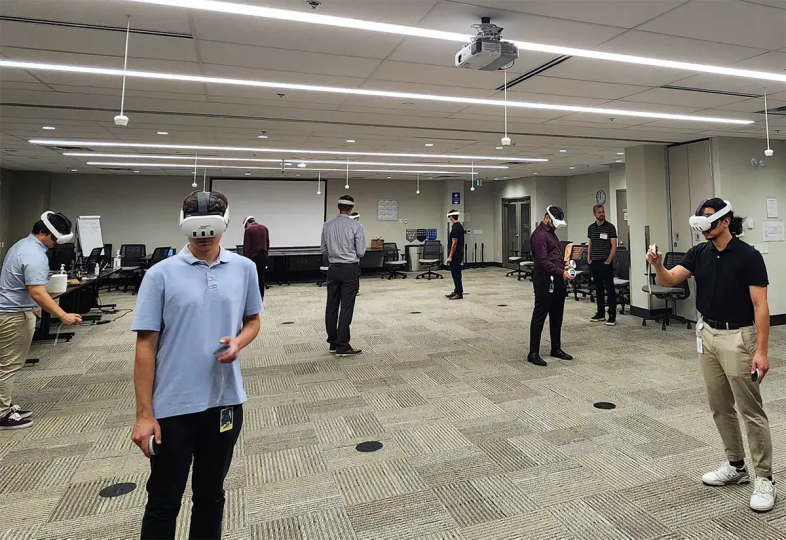
Toyota Material Handling needed to train technicians across 200+ North American dealerships on new forklift models without flying every learner to its Columbus, Indiana training center. VR Vision built interactive digital twins of Toyota's vehicles delivered through 300+ Meta Quest for Business headsets — including AI-guided procedural training, a multiplayer metaverse mode for live-led sessions, and an evaluation module that scores technician knowledge.
Result: Remote technician onboarding across 200+ dealershipsAvangrid — Energy & Utilities
Avangrid partnered with VR Vision to onboard new field workers into high-hazard maintenance and repair scenarios without the safety risk of real-environment training. Simulating live electrical and equipment environments in VR meant new hires arrived on day one already familiar with procedures, tools, and safety protocols.
Result: Significantly faster onboarding with improved task accuracyToronto Hydro — Utilities
Toronto Hydro rolled out VR training for bucket truck operations and line-worker procedures — letting new field staff practice dangerous, infrequent, high-consequence tasks in a controlled environment before ever stepping onto a real site. The deployment is now one of VR Vision's most-cited proof points for high-hazard training programs.
Result: 30% reduction in procedural errorsHow to Roll Out VR Onboarding in Your Organization
The companies getting real ROI from immersive onboarding follow a predictable rollout pattern. Here's the short version:
- Identify the highest-pain onboarding scenario first. Pick the procedure that's most expensive to train, most safety-critical, or most inconsistent across sites. That's your pilot.
- Build a digital twin of that one scenario. Resist scope creep. Prove the model with one well-built module before expanding.
- Deploy on standalone hardware. Meta Quest 3 or Quest 3S removes IT friction. No PCs, no cables, no dedicated VR rooms.
- Manage devices and content through a single platform. Vision Portal handles enterprise headset fleet management, content delivery, and learner performance analytics from one browser-based dashboard.
- Measure and expand. Track time-to-competency, error rates, and learner confidence before and after rollout. Scale to adjacent procedures once the data is in.
For a deeper, step-by-step blueprint, see our Enterprise Playbook for VR Training and the VR Training ROI Calculator.
Frequently Asked Questions
What is VR onboarding?
VR onboarding is the use of immersive virtual reality simulations to deliver structured, hands-on training to new employees in a digital twin of their real work environment. It replaces or supplements traditional classroom orientation, shadowing, and ride-alongs — and is used most heavily in industries where safety, consistency, and time-to-competency directly impact business outcomes.
How effective is VR training compared to classroom or e-learning?
Independent research from PwC shows VR learners retain up to 75% of training content vs. roughly 10% in classroom settings, acquire skills 4x faster, and report 275% higher confidence in applying what they've learned. A 2026 PwC study on immersive HR technology found VR onboarding increased learner motivation by 49% over traditional e-learning.
How long does it take to deploy a VR onboarding program?
A focused first module — covering one onboarding scenario — typically takes 8 to 16 weeks from kickoff to learner-ready deployment, depending on complexity. Most enterprise clients pilot one module, prove the ROI, then expand to additional procedures over the following quarters.
What hardware do employees need for VR onboarding?
Most enterprise programs in 2026 run on standalone headsets like the Meta Quest 3 or Quest 3S — no PC, no cables, no dedicated VR room required. Hardware costs start at approximately $500 per headset, and devices are managed remotely through enterprise platforms like Vision Portal.
Can VR onboarding integrate with our existing LMS?
Yes. VR training content can be delivered with SCORM and xAPI-compatible data so completion records, scores, and learner activity flow into corporate LMS systems. Note that LMS integration is delivered as a separate capability from the Vision Portal device and content management platform.
Which industries see the strongest ROI from VR onboarding?
The highest-ROI sectors are those where errors are expensive, training is dangerous, or scale makes consistent instruction difficult: energy and utilities, manufacturing and automotive, rail and transit, and large-footprint operations. Customers including Toyota, Avangrid, Coca-Cola, Enel, and Toronto Hydro have deployed VR Vision onboarding programs across these verticals.
Is VR training expensive at the enterprise level?
Initial content development represents the main investment — but the per-learner cost drops sharply as headcount grows. Standalone headsets have fallen roughly 80% in cost since 2020, and a single VR module can train thousands of learners across multiple sites with no incremental travel, instructor, or equipment costs. The break-even point is typically reached within the first hundreds of learners.
Ready to Modernize Your Employee Onboarding?
See how immersive VR can compress your onboarding timeline, lift retention, and give L&D measurable proof of competency — across every site.
Book a Live Demo →